The Great Schism of 1054: What Really Happened?
An in-depth investigation into the theological, political, and cultural forces that split Christianity in two, and why the wound has never fully healed.
Introduction: The Day Christianity Broke in Half
On a Saturday afternoon in July 1054, worshippers gathered inside the Cathedral of Hagia Sophia in Constantinople for afternoon prayers. What happened next would alter the course of world history. Cardinal Humbert and two other papal legates entered the building and made their way up to the sanctuary. They had not come to pray. They placed a Bull of Excommunication upon the altar and marched out once more. As he passed through the western door, the Cardinal shook the dust from his feet with the words: "Let God look and judge." A deacon ran out after him in great distress and begged him to take back the Bull. Humbert refused; and it was dropped in the street.
A week later, Cerularius convened a Holy Synod and excommunicated all the legates.
After roughly a thousand years of shared faith, the Christian Church had been formally and catastrophically divided. The Eastern Orthodox Church and the Roman Catholic Church, as distinct institutions, had been born. To understand what kind of Christianity the East was defending, see our Complete Beginner's Guide to Eastern Orthodox Christianity.
But here is what most people do not know: the date of 1054, while symbolically important, is in many ways a simplification. Today, no serious scholar maintains that the schism began in 1054. The process leading to the definitive break was much more complicated, and no single cause or event can be said to have precipitated it.
To understand what really happened, we need to go back centuries before Humbert set foot in Hagia Sophia.
Part I: The Long Estrangement
The Roman Empire Divides, and So Do Its Churches
The roots of the Great Schism of 1054 stretch all the way back to the division of the Roman Empire itself. When Emperor Diocletian split the vast territory into Western and Eastern halves for administrative purposes, he unknowingly set in motion a slow cultural and religious divergence. The Western half, centered on Rome, gradually developed its theology, liturgy, and church governance in Latin. The Eastern half, centered on Constantinople, did so in Greek.
When the Western Roman Empire collapsed under barbarian invasions in 476 AD, the two halves of Christendom found themselves not just geographically separated but culturally worlds apart. Theological vocabulary that could be precisely expressed in Greek became clumsy or subtly distorted in Latin translation, and vice versa. Misunderstandings that might have been corrected through conversation instead hardened into competing traditions over generations.
The Rise of Two Competing Power Centers
Rivalry developed in Slavic regions between Latin missionaries from the West and Byzantine missionaries from the East, who considered this territory to be Orthodox. Disputes over authority became even more heated in the 11th century as Rome asserted its primacy over all churches.
This was not a minor bureaucratic squabble. It went to the very heart of what the Church was and who had the right to define it. The primary causes of the East-West Schism were disputes over papal authority. The Roman Pope claimed he held authority over the four Eastern patriarchs, while the four Eastern patriarchs claimed that the primacy of the Patriarch of Rome was only honorary, and thus he had authority only over Western Christians.
From the Eastern Orthodox perspective, the Church had always been governed by a system of five roughly equal patriarchates: Rome, Constantinople, Alexandria, Antioch, and Jerusalem, each with authority over its own geographic territory. Rome's bishop held a primacy of honor as first among equals, but not a universal jurisdiction over all other bishops. Rome, increasingly, saw things very differently. This dispute over authority remains central to Orthodox theology today, as explored in our guide to Eastern Orthodox Christianity for beginners.
The Donation of Constantine: A Forgery That Shook the World
Making matters worse, in 1054, Pope Leo IX sent a letter to Michael Cerularius that cited a large portion of the forgery called the Donation of Constantine, believing it to be genuine. This document, later proven to be an eighth-century fabrication, purported to grant the papacy supreme authority over all spiritual and temporal matters in the Western world. The Eastern church viewed Rome's reliance on this document as both intellectually embarrassing and spiritually dangerous. It was precisely this kind of overreach that the East had been pushing back against for two centuries.
Part II: The Theological Fault Lines
The Filioque: One Word That Split Christendom
If the political dispute over papal authority was the engine of the Great Schism of 1054, the theological dispute over a single Latin word, filioque, was its most explosive fuel. The filioque controversy remains unresolved between Catholics and Orthodox to this day.
What is the Filioque?
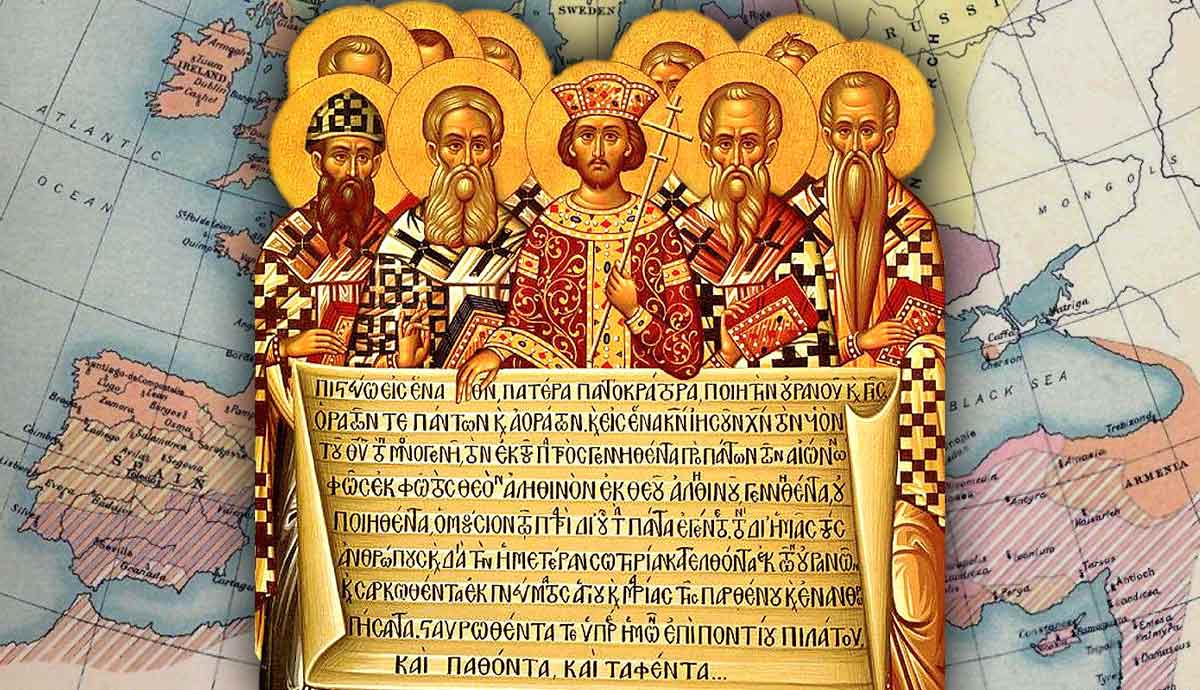
The original Nicene Creed, as formulated by the ecumenical councils of Nicaea (325) and Constantinople (381), declared that the Holy Spirit "proceeds from the Father." Western churches, beginning in sixth-century Spain, added the phrase "and from the Son" (filioque), so that the Spirit was said to proceed "from the Father and the Son." The Orthodox position holds that the Father alone is the eternal source of divinity within the Trinity. The Catholic position holds that the Spirit proceeds from the Father and the Son together.
This interpolation raised two entirely distinct problems. The first was procedural: the Western church had unilaterally altered a creed established by ecumenical councils. The East regarded this as an illegitimate exercise of authority that no single bishop, including the Bishop of Rome, had the right to undertake. The second issue was purely theological: did the addition represent sound doctrine or heretical innovation? Eastern theologians insisted that the Father alone is the eternal source of divinity within the Trinity, and that introducing the Son as a second source distorts the very nature of God.
To modern Western ears this may sound like hair-splitting, but for Orthodox theologians it was anything but. The addition of filioque became a convenient hook upon which to hang all the contention and disagreement between the churches. Scholars at Ligonier Ministries observe that filioque was the presenting problem, the tip of the iceberg, while the real mass lay hidden beneath the surface in centuries of accumulated grievance.
Liturgical and Disciplinary Disputes
Beyond the filioque, a thicket of liturgical differences had grown up between East and West over the centuries. Lesser matters related to worship and church discipline, for example married clergy (Orthodox) versus mandatory celibacy (Roman Catholic), rules of fasting, and tonsure practices, strained ecclesial relations year by year.
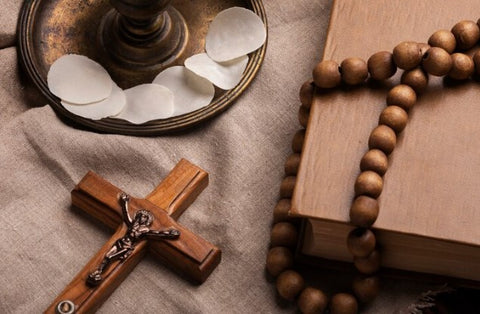
One of the flashpoints immediately preceding 1054 was the use of unleavened versus leavened bread in the Eucharist. The Great Schism occurred after Michael I, the Patriarch of Constantinople, ordered Leo, the Archbishop of Ochrid, to write a letter to John, the bishop of Trani, attacking the "Judaistic" practices of the West, namely the use of unleavened bread. This letter was sent to bishops across the West, including the Pope himself, and ignited a furious response. To understand how deeply the Eucharist matters in Orthodox theology, see our piece on the Divine Liturgy.
As scholars writing at Brewminate have noted, one Catholic-Eastern church historian rightly characterized the dispute over unleavened bread as a "grotesque disproportion between doctrinal relevance and ecclesial consequences." And yet the bread dispute mattered because it was symptomatic of a deeper, more troubling reality: two churches that could no longer agree on what authentic Christian tradition looked like.
Part III: The Political Context
The Charlemagne Factor
The medieval schism cannot be understood without recognising how deeply political it was. The dispute took place just as the Carolingian ruler Charlemagne was making his claim to imperial status. When he was crowned emperor in 800 by the Pope, the act carried enormous symbolic weight: it implied that the true continuation of Roman imperial authority now resided in the West. From a Byzantine perspective, this was an extraordinary and deeply provocative claim.
The Byzantines considered themselves the true and only continuation of the Roman Empire. The idea that a Frankish king in the West could simply declare himself Roman Emperor with the Pope's blessing was, to Constantinople, an act of breathtaking arrogance, and yet another sign that Rome was acting unilaterally in ways that undermined the older order of Christendom.
Pope Leo IX and Michael Cerularius: The Wrong Men at the Wrong Time
By 1054, the accumulated tensions of centuries were ready to ignite. All that was needed was the wrong personalities in the wrong moment. They arrived precisely on schedule.
Pope Leo IX and Patriarch of Constantinople Michael Cerularius heightened the conflict by suppressing Greek and Latin practices in their respective domains. In 1054, Roman legates traveled to Cerularius to deny him the title Ecumenical Patriarch and to insist that he recognize the Church of Rome's claim to be the head and mother of all churches. Cerularius refused.
The choice of Cardinal Humbert as the lead legate was unfortunate, for both he and Cerularius were men of stiff and intransigent temper, whose mutual encounter was not likely to promote good will among Christians. The legates, when they called on Cerularius, did not create a favourable impression. Thrusting a letter from the Pope at him, they retired without giving the usual salutations; the letter itself, although signed by Leo, had in fact been drafted by Humbert, and was distinctly unfriendly in tone. After this the Patriarch refused to have further dealings with the legates.
As historians at The Exalted Christ note, Humbert considered Eastern Christians barely Christian, while Cerularius saw the papacy as a Western innovation threatening the authentic faith. When these two men met, the outcome was almost predetermined.
Part IV: July 16, 1054
A Questionable Excommunication
On arriving in the imperial city in April 1054, Humbert launched into a vicious criticism of Cerularius and his supporters. But the patriarch ignored the papal legate entirely, and an angry Humbert stalked into Hagia Sophia and placed on the altar the bull of excommunication.
The document was remarkable for its fury and its errors. Among its charges, Humbert actually accused the Greeks of omitting the Filioque from the Creed, when in reality it was the West that had added it. The bull also contained numerous other factual mistakes and inflammatory rhetoric that undermined its credibility even in Rome.
Was the 1054 excommunication even legally valid?
Humbert placed the papal bull on the altar of Hagia Sophia unaware that Pope Leo IX had died weeks earlier, in April 1054. A legate acting under a deceased pope had no canonical authority to issue such a document. Leo had not seen or signed it. His successor, Victor II, was not elected until the end of 1054, meaning he could have revoked Humbert's action entirely but chose not to do so. Many historians argue the excommunication was canonically void from the start.
Cerularius Responds
In return, Patriarch Michael excommunicated Cardinal Humbert and the Pope, followed by removing the name of the Pope from the diptychs, the liturgical list of those commemorated in prayer, thus symbolically severing communion between the two sees.
And then, remarkably, almost nothing happened. Dramatic though they were, the events of 1054 were not recorded by the chroniclers of the time and were quickly forgotten. Negotiations between the pope and the Byzantine emperor continued, especially in the last two decades of the century, as the Byzantines sought aid against the invading Turks. In 1095, to provide such help, Pope Urban II proclaimed the Crusades. Certainly there was no recognized schism between the churches at that time.
This is the great paradox of 1054: at the time, almost nobody recognized it as the definitive break. Diplomatic contact continued. The two churches still considered themselves part of the same Christian family. What made 1054 permanent was not 1054 itself, but what came after.
Part V: What Truly Sealed the Schism
The Fourth Crusade and the Sack of Constantinople, 1204
If 1054 was the symbolic date of the East-West Schism, 1204 was the date it became truly irreversible. In April 1204, the Crusaders of the West invaded and conquered the Christian Eastern Orthodox city of Constantinople, capital of the Byzantine Empire. This is seen as one of the most catastrophic and defining acts in the history of the Catholic-Orthodox split. It has been described as one of the most profitable and disgraceful sacks of a city in recorded history.
Thousands of Orthodox Christians were murdered, churches and icons were desecrated, and an undying hostility developed between East and West that no diplomatic gesture since has fully overcome.
The looting and destruction of Orthodox churches, monasteries, and cultural treasures by the crusaders caused wounds in the Orthodox Christian community that went far beyond the material. These acts were viewed not just as physical destruction but as profound sacrilege and betrayal by fellow Christians. Men who had taken the cross in the name of Christ had turned on the very heart of Eastern Christendom.
The capture and sack of Constantinople in 1204 and the imposition of Latin Patriarchs made reconciliation immeasurably more difficult. This included the theft of precious religious artifacts and the destruction of the Library of Constantinople, one of the great repositories of ancient learning.
"Better the Turk Than the Pope"
The legacy of 1204 was a bitterness so deep it shaped Orthodox consciousness for generations. On the edge of destruction in 1453, as the Ottomans laid siege to Constantinople, the people of the city refused any meaningful help from the Catholics. "Better death by the Turk than slavery to Rome" became the defining motto of the age.
Constantinople fell to the Ottomans in 1453. The Byzantine Empire was no more. And in 1484, a Synod of Constantinople repudiated the Union of Florence, making the breach between the Patriarchate of the West and the Patriarchate of Constantinople formally and finally permanent.
Part VI: The Orthodox Perspective
What Rome Got Wrong, According to the East
From the Orthodox side, the Great Schism was not a mutual rupture between equals. It was Rome's departure from authentic apostolic tradition. From the Eastern Orthodox perspective, the biggest single reason for the schism was the reassertion of Papal claims to have jurisdictional authority over all the Churches of Christendom, a claim that had no genuine precedent in the canons of the first four Ecumenical Councils and no grounding in the ecclesiology of the early Church.
In the Orthodox view, it was Rome that innovated: unilaterally altering the Creed, fabricating documents to support its authority claims, and imposing a monarchical model of church governance that the East had never accepted. The East did not leave Rome. In the Orthodox telling, Rome left the ancient consensus of the Church, and the East simply refused to follow. This understanding of the Church's structure remains foundational to Eastern Orthodox theology and is examined in depth in our article on what theosis means in the Orthodox tradition.
The spiritual disciplines that shaped Orthodox resistance to Rome, including fasting, prayer, and the monastic tradition, were also deeply formative. See our guide to fasting in the Orthodox Church and our piece on the Desert Fathers and the birth of Christian monasticism for the deeper roots of this tradition.
The Attempts at Reunification, and Their Failure
On paper, the two churches actually reunited twice: in 1274 by the Second Council of Lyon and in 1439 by the Council of Florence. In each case the councils were repudiated by the Orthodox as a whole, on the grounds that the hierarchs had overstepped their authority in consenting to reunification without the consent of the whole Church.
Each attempted reunion failed for the same reason: ordinary Orthodox clergy and faithful simply refused to accept what their bishops had signed. The split was not merely institutional. It lived in the hearts and memories of the people.
Part VII: Toward Reconciliation
Lifting the Anathemas in 1965
For nine centuries, the mutual excommunications of 1054 stood as a formal barrier between the two churches. Then, on December 7, 1965, one day before the close of the Second Vatican Council, something extraordinary happened. Pope Paul VI and Ecumenical Patriarch Athenagoras I jointly promulgated a decree that lifted the mutual excommunications of 1054 and declared, "These censures were not intended to break ecclesiastical communion between the Sees of Rome and Constantinople."
Those excommunications were reversed, to be replaced by relationships of love. They were "erased from the memory of the Church" and "consigned to oblivion." It was a gesture of enormous symbolic importance, even if it did not resolve the underlying theological disagreements that caused the schism in the first place.
The Dialogue Continues
The growing dialogue of charity between Catholics and Orthodox led to the establishment of an official International Joint Commission for Theological Dialogue between the two churches, launched by Ecumenical Patriarch Dimitrios I and Pope John Paul II when the Pope visited Istanbul in November 1979.
In April 2004, on the 800th anniversary of the sack of Constantinople, Ecumenical Patriarch Bartholomew I formally accepted a Catholic apology for the events of 1204, saying: "The spirit of reconciliation is stronger than hatred."
Yet the dialogue, however warm, has not produced reunion. The theological issues, particularly the filioque and papal primacy, remain unresolved. The Orthodox churches reject the Catholic doctrine of papal infallibility and universal jurisdiction. Rome has shown willingness to discuss these matters but has not abandoned its essential claims. The question of whether Jesus himself intended a monarchical papacy is explored in our article Jesus: Man or Myth?
Conclusion: Why It Still Matters
The Great Schism of 1054 is not merely ancient history. It gave birth to two of the world's largest Christian traditions: the Roman Catholic Church with over 1.3 billion members, and the Eastern Orthodox Church with over 260 million. Their differences in theology, liturgy, ecclesiology, and spirituality remain very much alive nearly a thousand years later.
What the story of 1054 ultimately reveals is that great institutional ruptures rarely happen in a single moment. They are the product of centuries of misunderstanding, competition, pride, and failure to truly listen across cultural divides. The events of July 16, 1054 were real and dramatic, but they were also a symptom of a disease that had been spreading for six hundred years before Humbert ever walked into Hagia Sophia.
The wound has not healed. But the conversation, at least, has resumed.
Frequently Asked Questions
What caused the Great Schism of 1054?
The Great Schism of 1054 was caused by a combination of theological, political, and cultural disputes building for centuries. The two primary causes were the dispute over papal authority, with Rome claiming universal jurisdiction while the Eastern patriarchs rejected this, and the Filioque controversy, in which the Western church unilaterally added "and from the Son" to the Nicene Creed. Secondary causes included differing liturgical practices, language barriers between Latin and Greek, and political rivalries between the Byzantine Empire and the emerging Western kingdoms.
What is the Filioque and why did it cause the Great Schism?
The Filioque is a Latin word meaning "and from the Son." The original Nicene Creed declared that the Holy Spirit proceeds from the Father alone. Beginning in sixth-century Spain, Western churches began adding "and from the Son," so the Spirit was said to proceed from both Father and Son. The Eastern Orthodox Church rejected this on two grounds: the West had no authority to unilaterally alter a creed established by ecumenical councils, and the addition distorted the Orthodox understanding of the Trinity by introducing a dual source of divinity.
What exactly happened on July 16, 1054 in Hagia Sophia?
On July 16, 1054, Cardinal Humbert, the papal legate, entered the Cathedral of Hagia Sophia during afternoon prayers and placed a bull of excommunication on the altar, formally excommunicating Patriarch Michael Cerularius. He then walked out and shook the dust from his feet at the door. One week later, Cerularius convened a Holy Synod and excommunicated Cardinal Humbert and the papal legates in return. Notably, the excommunication was of questionable validity because Pope Leo IX had died in April, meaning Humbert had no living pope authorizing his actions.
Did the Great Schism happen all at once in 1054?
No. While 1054 is the symbolic date, no serious scholar today maintains the schism happened in a single moment. The events of 1054 were barely recorded by contemporaries and quickly forgotten. Diplomatic contact between Rome and Constantinople continued for decades afterward. What truly made the schism permanent was the Fourth Crusade and the sack of Constantinople in 1204, when Western crusaders invaded and looted the heart of Eastern Christendom, creating a bitterness that has never fully healed.
Were the excommunications of 1054 ever lifted?
Yes. On December 7, 1965, one day before the close of the Second Vatican Council, Pope Paul VI and Ecumenical Patriarch Athenagoras I jointly lifted the mutual excommunications of 1054 and declared they were "erased from the memory of the Church." However, lifting the excommunications did not end the schism. The theological issues, particularly the Filioque and papal primacy, remain unresolved, and the two churches are still not in communion.
What is the difference between the Catholic Church and the Eastern Orthodox Church?
The primary differences are: (1) Authority: Catholics accept the Pope as having universal jurisdiction; Orthodox reject this, holding that all patriarchs are equal in authority. (2) The Filioque: Catholics hold the Holy Spirit proceeds from both Father and Son; Orthodox hold it proceeds from the Father alone. (3) Papal infallibility: Catholics accept this doctrine defined in 1870; Orthodox reject it entirely. (4) Liturgical traditions: the two churches developed distinct practices, music, iconography, and devotional customs over centuries of separation.
How did the Fourth Crusade deepen the Great Schism?
The Fourth Crusade of 1202 to 1204 was meant to recapture Jerusalem but instead diverted to Constantinople. In April 1204, Western crusaders sacked the city: destroying churches and icons, stealing religious artifacts, killing Orthodox Christians, and imposing Latin patriarchs in place of Orthodox ones. This betrayal by fellow Christians created a depth of bitterness that made genuine reconciliation nearly impossible. On the eve of Constantinople's fall to the Ottomans in 1453, the city's residents famously preferred Ottoman rule to reunion with Rome.
Further Reading and Sources
- OrthodoxWiki: Great Schism
- Britannica: The Schism of 1054
- Britannica: Michael Cerularius
- Orthodox Church in America: The Great Schism
- Theopedia: Great Schism
- Christian History Institute: East-West Schism
- Ligonier Ministries: The Great Schism of 1054
- Brewminate: Filioque and the Great Schism
- Medievalists.net: Why the Great Schism Is a Medieval Myth
- GEOPOL: The Great Schism
- Greek Reporter: The Great Schism
- OrthodoxWiki: Fourth Crusade
- OrthodoxWiki: Humbert of Silva Candida
- Vatican: Catholic-Orthodox Joint Declaration 1965
- USCCB: Catholic-Orthodox Dialogue
- Greek Orthodox Archdiocese: 50th Anniversary of Lifting Anathemas
- Desiring God: Father, Son, and Controversy
Kai Tutor | The Societal News Team
Follow Us!
It helps decentralize our presence across the web and it is completely free!
Orthodoxy Instagram ➤
Instagram ➤
Youtube ➤
Substack ➤
X.com ➤
Telegram ➤
TikTok ➤