The Only One Going Backward
The U.S. is the only G7 wealthy nation where quality of life is actively getting worse. The data across happiness, health, housing, wages, and social connection points in one direction, and it is not subtle.

The Premise
There is a version of America that exists in political speeches and national mythology. It is the wealthiest country in the world, the land of opportunity, the place where hard work is rewarded and freedom is guaranteed. By raw GDP, that country still exists. By nearly every measure that actually touches the lives of ordinary people, it is coming apart.
The United States is not just underperforming its G7 peers. It is the only member of that group where the fundamental conditions of daily life are in measurable, sustained, documented decline. Not stagnating. Not plateauing. Getting worse. And the data is not subtle. The same dynamic appears when examining how official economic statistics are constructed, as we documented in our analysis of how inflation figures systematically undercount the real cost of living.
Happiness: A Generational Collapse
In 2011, the U.S. placed 11th on the World Happiness Report. By 2016, it had dropped to 14th. By 2020, it was 19th. In 2025, the U.S. ranked 24th, its lowest place in the history of the report, which has been published since 2012. That is a 13-place fall in roughly a decade, while the Nordic nations, Canada, Germany, and other wealthy peers held steady or improved.
The 2024 report showed the U.S. experienced one of the sharpest drops globally in life evaluation scores between 2006 to 2010 and 2021 to 2023, with a 0.545-point decline on the 10-point Cantril Ladder scale. The generational split is especially alarming. Americans under 30 rank 62nd in the world for life satisfaction, while those over 60 rank 10th. The country that used to promise its young people the most is now failing them at a scale unmatched by any other wealthy democracy.
Health: Spending More, Getting Less, Dying Sooner
No data point captures the American paradox more precisely than health outcomes. In 2024, the United States spent an estimated $14,885 per person on healthcare, the highest of any comparable country. Switzerland was second at $9,963, while the average for wealthy OECD countries excluding the U.S. was $7,371 per person. America is spending roughly twice what its peers spend. What does it get for that?
The trajectory makes the story worse. Life expectancy is forecasted to increase only modestly to 80.4 years by 2050, lowering the country's global ranking from 49th in 2022 to 66th in 2050 among 204 countries tracked by IHME. The U.S. is not just behind. It is falling further behind, year by year. Contributing factors include lack of universal coverage, weak primary care infrastructure, high out-of-pocket costs, a complex insurance system, and high rates of gun violence, opioid overdoses, and obesity.
Housing: The American Dream, Priced Out
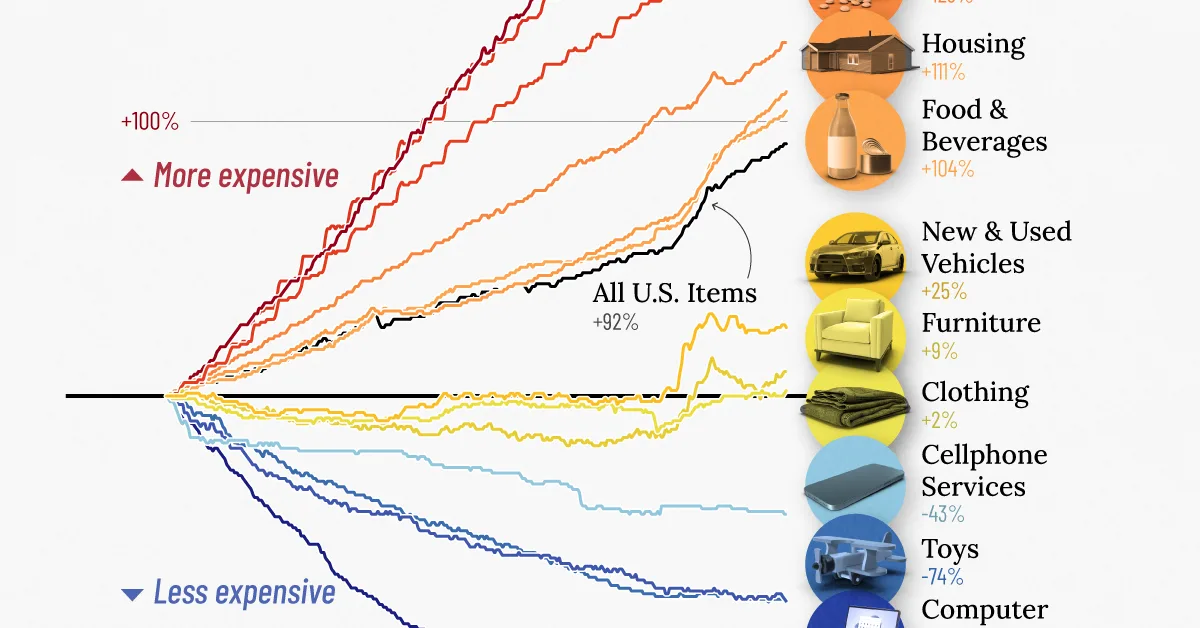
For most of the 20th century, homeownership was the material foundation of the American middle class. That foundation is cracking. Home prices are up 60% since 2019, and the median existing single-family home price hit a new high of $412,500 in 2024, roughly five times the median household income and significantly above the price-to-income ratio of 3 that has traditionally been considered affordable.
While housing affordability is a challenge across several wealthy nations, the American case is distinctive in its severity and in its coupling with an absence of social safety nets. In Germany, France, and the Netherlands, steep housing costs are partially offset by strong tenant protections, universal healthcare, and robust unemployment insurance. In the U.S., losing your housing often means losing everything else simultaneously. This same dynamic, where the cost of essential goods rises while wages fail to keep pace, is documented in detail in our analysis of how the labor market is failing American workers.
The Wage-Productivity Betrayal
The U.S. economy is productive. Workers are more efficient than at any point in history. None of that efficiency is reaching them. Since 1979, productivity has grown 2.7 times more than typical worker pay. Between the late 1940s and 1960s, productivity and pay grew almost in parallel. That relationship broke in the late 1970s, and wages have not caught up since.
Loneliness and the Collapse of Social Fabric
The World Happiness Report identified one specific behavioral driver behind America's declining scores: people are increasingly eating alone. That single detail is a proxy for something much larger. Nowhere is the loneliness gap as large as in the U.S., where young men are uniquely lonely at 25%, compared with 17% of all other U.S. adults. Across the OECD, 36% of both young men and other adults report feeling worried the previous day, but 46% of young American men report daily worry, compared with 37% of other U.S. adults.
What Makes the U.S. Unique Among the G7
Every other G7 nation has problems. Housing costs are rising across the developed world. Mental health pressures have increased globally. Economic inequality is not a uniquely American concern. But the U.S. is the only G7 member where these problems are accelerating simultaneously, without the structural buffers that other wealthy democracies have built. Universal healthcare absorbs the blow of job loss in Germany and Japan. Strong tenant protections limit housing precarity in France. Higher union density in Canada and the UK ensures wages track more closely with productivity.
The American model, built on market provision of healthcare, housing, and retirement security, worked tolerably when wages rose alongside productivity, when housing was cheap relative to income, and when stable employment was the norm. All three of those conditions have now eroded, and there is no public floor to catch people when they fall.
The Arithmetic of Decline
There is a final number worth sitting with. In June 2021, 59.2% of Americans described themselves as thriving. By early 2025, that number had fallen to 48.9%. That 10-point collapse in four years represents tens of millions of people who looked at their lives and concluded that things were not going well.
Those people are not wrong. The healthcare they cannot afford is real. The homes they cannot buy are real. The wages that have not kept up with the cost of living are real. The friends they no longer have are real. The U.S. remains the largest economy on earth. It retains extraordinary concentrations of wealth, talent, and innovation. But an economy is not the same thing as a society, and GDP is not the same thing as a life. By the measures that actually determine whether ordinary people can build stable, dignified, connected lives, the United States is the only G7 nation moving in the wrong direction. That is not a talking point. It is what the data says.
Frequently Asked Questions
Is the United States falling behind other wealthy countries?
Yes. The U.S. is the only G7 nation where happiness, health outcomes, housing affordability, wage growth relative to productivity, and social connection are all in simultaneous, sustained decline. In 2025 the U.S. ranked 24th in the World Happiness Report, its lowest ever, down from 11th in 2011. Americans under 30 rank 62nd globally for life satisfaction. The U.S. has the lowest life expectancy in the G7, the highest per-person healthcare spending of any country, and the highest rates of preventable death among wealthy nations.
Why does the U.S. have poor health outcomes despite spending the most on healthcare?
The U.S. spent an estimated $14,885 per person on healthcare in 2024, more than any comparable country and roughly twice the OECD average. Despite this, the U.S. has the lowest life expectancy in the G7 at 79 years, and a maternal mortality rate three times the OECD average. The Commonwealth Fund ranked the U.S. last among wealthy nations on health system performance in 2024. Contributing factors include lack of universal coverage, high out-of-pocket costs, a complex insurance system, and high rates of gun violence, opioid overdoses, and obesity.
How has U.S. happiness changed over the past decade?
The U.S. placed 11th in the World Happiness Report in 2011, fell to 14th by 2016, 19th by 2020, and reached its lowest-ever ranking of 24th in 2025. Americans under 30 rank 62nd globally for life satisfaction. The share of Americans describing themselves as thriving fell from a record 59.2% in June 2021 to 48.9% by early 2025, representing an estimated 27 million fewer thriving Americans in four years.
Has the wage-productivity gap gotten worse in the U.S.?
Yes. Since 1979, productivity has grown 2.7 times more than typical worker pay. Between the late 1940s and 1960s, productivity and wages grew nearly in parallel. That relationship broke in the late 1970s and has not recovered. Net productivity has grown an expected 70% while hourly compensation has grown only 12%. Policy changes, deregulation, and declining unionization since 1978 have greatly contributed to this stagnation.
How bad is the U.S. housing affordability crisis?
Home prices are up 60% since 2019. The median existing single-family home price hit $412,500 in 2024, roughly five times the median household income. Households earning $75,000 can afford only 21% of listings in 2025, down from 49% in 2019. Households earning $100,000 saw their affordable options fall from 65% to 37% over the same period. Homelessness reached 771,480 people in January 2024, a 33% increase since 2020.
Kai Tutor | The Societal News Team
Follow Us!
It helps decentralize our presence across the web and it's completely free!
Instagram ➤
Youtube ➤
Substack ➤
X.com ➤
Telegram ➤
TikTok ➤
Sources: Institute for Health Metrics and Evaluation (IHME), U.S. Life Expectancy Forecasts to 2050 | CBS News, 2025 World Happiness Report: U.S. at Lowest-Ever Ranking | Gallup, Americans' Life Ratings Slump to Five-Year Low | Peterson-KFF Health System Tracker, U.S. Life Expectancy vs. Other Countries | Our World in Data, U.S. Healthcare Spending vs. G7 Nations | Commonwealth Fund, Mirror Mirror 2024: A Portrait of the Failing U.S. Health System | Commonwealth Fund, U.S. Health Care from a Global Perspective 2026 | Visual Capitalist, Housing Affordability in the U.S. by Income Level | Harvard Joint Center for Housing Studies, Worsening Affordability Crisis | Economic Policy Institute, The Productivity-Pay Gap | Clockify, Implications of the Productivity-Pay Gap 1979-2026 | Gallup, Younger Men in the U.S. Among the Loneliest in the West | Pew Charitable Trusts, America's Mental Health Crisis | American Institute for Boys and Men, Mental Health Statistics