GDP Tells Us Almost Nothing About Civilizational Success
From ancient Athens to modern Scandinavia, the civilizations we most admire were never the wealthiest. So why do we keep measuring ourselves as if they were?
The Warning Nobody Remembered
In the spring of 1934, the economist Simon Kuznets delivered a report to the United States Congress that would quietly reshape the modern world. The document introduced a new accounting framework, a single number designed to capture the total productive output of a national economy. Kuznets called it national income. We came to know it as Gross Domestic Product.
What is less often remembered is the warning he included in the same report.
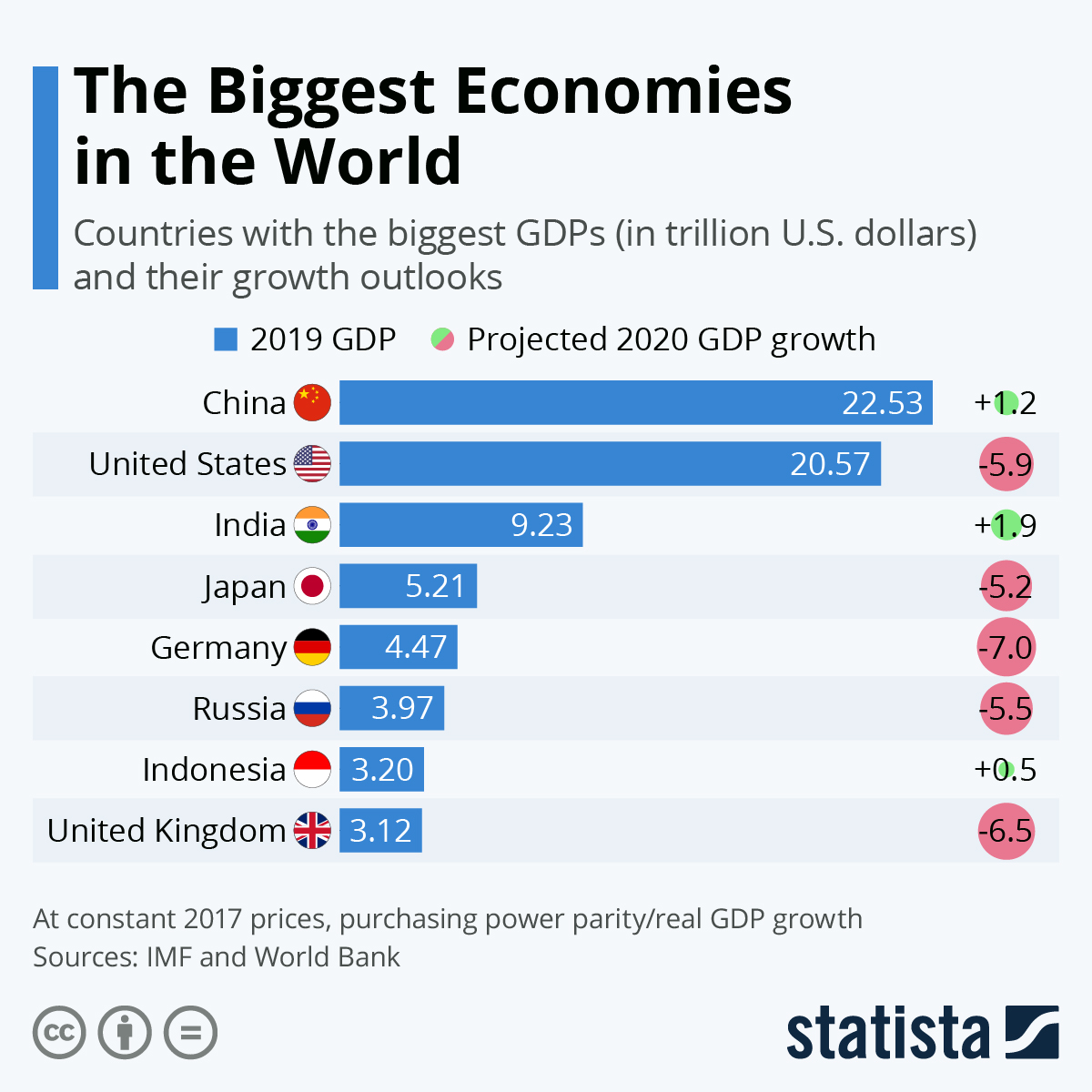
Ninety years later, that warning has been almost entirely forgotten. GDP is now the master metric of global civilization, the figure that moves financial markets, determines credit ratings, guides foreign aid, and decides political careers. Nations are ranked by it. Progress is defined by it. Success, in the language of contemporary governance, is largely synonymous with it.
And yet, when we look back across history at the civilizations we consider great, the ones we travel to see, the ones we study, the ones whose ideas still shape how we live, almost none of them were the wealthiest of their age. We do not remember them for their output. We remember them for something harder to quantify, and far more important: how well, and how meaningfully, their people actually lived.
How an Emergency Tool Became a Philosophy
To understand how GDP came to dominate our idea of success, it helps to understand what it was originally designed to do. The 1930s were a moment of acute economic emergency. The Great Depression had destroyed livelihoods across the industrialized world, and governments were largely flying blind, with no reliable way to measure the scale of the collapse or track whether recovery efforts were working.
Kuznets' framework gave policymakers a tool for precisely that purpose: a snapshot of economic activity that could be measured, compared, and tracked over time. During World War II, the methodology was refined further, this time to assess industrial capacity and how much the Allied economies could actually produce for the war effort.
As an instrument for those specific purposes, GDP worked well. The problem came afterward, when the emergency metric was quietly promoted into a permanent philosophy. As the postwar international order took shape with the World Bank, the IMF, and the United Nations all requiring standardized national accounts, GDP became the universal language of development. To be a successful nation was, increasingly, to be a growing one.
The Civilizations History Actually Remembers
Walk into any serious history classroom and ask students to name the great civilizations of antiquity. They will name Athens, Rome, the Han Dynasty, the Maya, the Ottomans, the Mughal Empire. Ask them why, and the answers will almost never involve trade balances or aggregate production figures.
Athens is remembered for philosophy, for the invention of democratic governance, for the public life of the agora, the culture of debate, theater, and civic participation that Pericles, in his famous funeral oration, described as "an education to Greece." The city-state was not the wealthiest power in the ancient Mediterranean; Persia and Egypt commanded far greater material resources. What Athens produced, in its relatively brief Golden Age, was a set of ideas that have reverberated for two and a half millennia.
The Maya civilization, which flourished across present-day Mexico and Central America for more than a thousand years, is studied for its extraordinary achievements in astronomy, mathematics, architecture, and agricultural engineering. Scholars who examine the Terminal Classic period, when major Maya centers were gradually abandoned beginning around 800 CE, approach the subject with something close to mourning. The question they ask is not what happened to the trade networks. It is what was lost: a sophisticated urban culture, a complex written tradition, an accumulated body of knowledge about the natural world that took centuries to build.
The Song Dynasty in China, which ruled from 960 to 1279 CE, is considered by many historians to be one of the most intellectually productive eras in human history. Moveable type, paper money, gunpowder weapons, and the magnetic compass for navigation all emerged during this period. The Song also developed a meritocratic civil service system, sophisticated landscape painting, and a vibrant urban culture. When historians celebrate the Song, they are celebrating a civilization that made space for inquiry, artistry, and learning. Output is a footnote.
In North America, the Haudenosaunee Confederacy, also known as the Iroquois, created a system of democratic governance that brought together six distinct nations under a shared constitutional framework called the Great Law of Peace. The Confederacy endured for centuries, managing conflict through deliberation rather than conquest. Several American founders, including Benjamin Franklin, acknowledged studying the Haudenosaunee model while drafting the structures of the new republic. Their measure of success was stability, justice, and the peaceful transmission of governance across generations. There is no GDP figure for it. There does not need to be.
The Countries Trying Something Different
A handful of contemporary nations have begun, seriously and methodically, to try a different approach.
Bhutan is the most famous example. In 1972, the country's fourth king declared that Bhutan would pursue Gross National Happiness rather than Gross National Product. The phrase was initially treated as a philosophical curiosity, the whimsy of a small Buddhist kingdom tucked into the Himalayas. Over time, it became something more substantial. Bhutan developed a formal GNH Index measuring nine domains of wellbeing: living standards, health, education, governance, ecological diversity, time use, psychological wellbeing, cultural resilience, and community vitality. The government runs GNH surveys and uses the results to guide policy. Proposed legislation is assessed not only for its economic impact but for its effect on happiness.
Bhutan remains a poor country by GDP measures, and it faces genuine development challenges. But its insistence on asking the right questions, what does it actually mean for people to be doing well, has made it a reference point for policymakers around the world wrestling with the inadequacy of growth metrics.
New Zealand has pursued a similar experiment at a larger scale. In 2019, Prime Minister Jacinda Ardern introduced the country's first "Wellbeing Budget," directing government spending toward explicit social outcomes: mental health, child poverty reduction, indigenous wellbeing, and the transition to a low-carbon economy. The initiative was a formal acknowledgment that GDP growth, while valuable, could coexist with serious social deterioration, and that government had a responsibility to measure and address both.
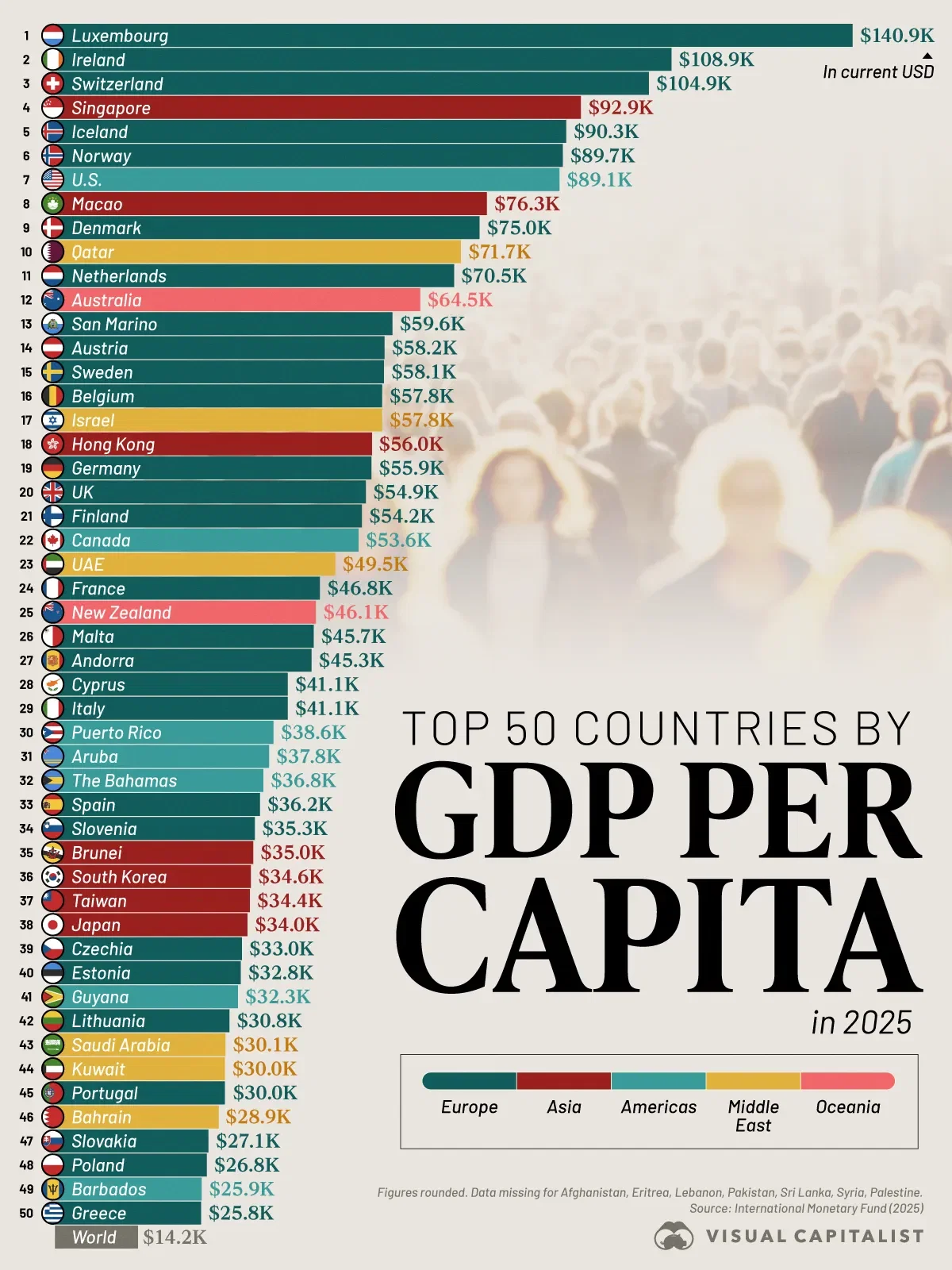
The Nordic countries represent perhaps the most developed version of this alternative model, though they arrived at it through decades of incremental policy rather than a single philosophical declaration. Denmark, Finland, and Norway consistently rank among the highest in the world on measures of happiness, social trust, life satisfaction, and perceived quality of life. Their GDP figures are high, but not uniquely so. Several wealthier countries score much lower on the same wellbeing measures. What distinguishes the Nordic model is not production but security: the reduction of precarity through universal healthcare, generous parental leave, low-cost higher education, strong labor protections, and a broadly shared sense that institutions can be trusted to function in the public interest.
The Most Productive Civilization in History
These historical and contemporary examples raise an uncomfortable question about the societies that currently top the GDP rankings.
The United States, by total economic output, is the most productive civilization in recorded history. It is also, by numerous measures, experiencing significant social deterioration. Life expectancy, which had been rising steadily for decades, began declining before the Covid-19 pandemic and has not fully recovered. Rates of reported loneliness have increased substantially, particularly among young people; the U.S. Surgeon General declared loneliness a public health epidemic in 2023. Survey data consistently shows that Americans work longer hours than citizens of comparable wealthy nations, with less vacation time, weaker job protections, and higher rates of work-related stress.
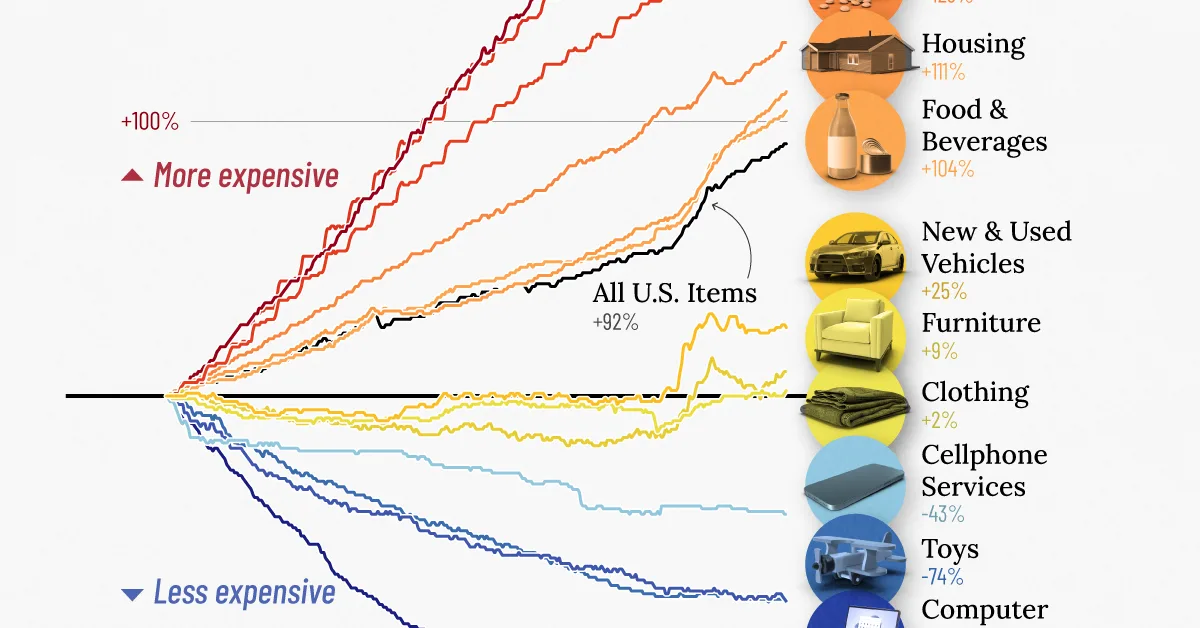
None of this appears in the GDP figures. A person who works two jobs, cannot afford to see a doctor, and has no time for friends or community contributes positively to GDP. A person who grows much of their own food, cares for elderly neighbors, and participates actively in local civic life may contribute relatively little. The metric cannot distinguish between these lives. It was not designed to. The same blind spot is visible in how official inflation figures are constructed, stripping out food and energy costs to produce a number that bears little resemblance to what working Americans actually experience, as we documented in our analysis of how purchasing power has eroded since 2000.
Better Frameworks Already Exist
Economists Kate Raworth and Mariana Mazzucato, among others, have argued for what Raworth calls a "doughnut" model of economic thinking, one that sets a floor of basic needs below which no one should fall, and a ceiling of ecological impact above which no society should climb, with human flourishing as the explicit goal within that range. It is a framework borrowed less from the traditions of industrial capitalism than from the older question that Aristotle called the central problem of politics: what kind of life do we want to make possible for human beings? The distance between that question and current practice is illustrated starkly by how the most powerful economic actor on earth currently operates, as our analysis of the Trump family's revenue streams documents in detail.
Every era tends to assume it represents the pinnacle of progress. The Romans had this confidence. The Victorians had it in abundance. The twentieth century's faith in development, measurable, quantifiable, achievable through the right combination of capital and policy, was perhaps the most systematic version of it. Posterity is rarely so affirming.
What Future Historians Will Want to Know
Future historians of our era will have access to our numbers. They will know exactly how much we produced, what our growth rates were, how the markets moved. What they will want to understand, looking back, is something harder: what it was actually like to be alive here. Whether people had time for the things that mattered to them. Whether they trusted each other and their institutions. Whether they felt their lives had meaning. Whether they left the world better than they found it.
The civilizations we admire most, Athens, the Song Dynasty, the Haudenosaunee, the societies that built Chartres or Machu Picchu or the libraries of Timbuktu, were not necessarily the wealthiest of their time. They were the ones that, in various ways and with various imperfections, created conditions in which human life could be rich in the ways that actually matter: in knowledge, community, beauty, purpose, and belonging.
We already know this, intuitively, every time we stand in front of something those civilizations left behind and feel the weight of what was achieved there. The task is to remember it when we turn our attention to ourselves and to build measurement systems worthy of the question we are actually trying to answer.
Simon Kuznets warned us in 1934. The better metrics exist. The harder work is deciding, collectively, that flourishing, not growth, is what we are actually for.
Frequently Asked Questions
Why is GDP a flawed measure of national success?
GDP was designed in the 1930s as an emergency tool to measure economic output during the Great Depression, not as a measure of human wellbeing. Its inventor, Simon Kuznets, explicitly warned in 1934 that the welfare of a nation can scarcely be inferred from a measurement of national income. GDP counts all economic activity equally, cannot distinguish between a person working two jobs with no time for community and a person living a rich, connected life, and excludes social trust, health, meaning, and environmental sustainability entirely.
What is Gross National Happiness and how does Bhutan use it?
Gross National Happiness is a development philosophy introduced by Bhutan's fourth king in 1972. Bhutan developed a formal GNH Index measuring nine domains: living standards, health, education, governance, ecological diversity, time use, psychological wellbeing, cultural resilience, and community vitality. The government uses GNH survey results to guide policy and assesses proposed legislation for its effect on happiness, not just economic output.
Which civilizations does history remember most and why?
History's most admired civilizations, including ancient Athens, the Song Dynasty, the Haudenosaunee Confederacy, and the Maya, are remembered not for their economic output but for their contributions to philosophy, governance, science, art, and civic life. Athens invented democratic governance. The Song Dynasty produced moveable type, paper money, and the compass. The Haudenosaunee created a constitutional framework for peaceful governance across six nations. None of these achievements are captured by GDP.
Why do Nordic countries rank highest in wellbeing despite not having the highest GDP?
Denmark, Finland, and Norway rank consistently among the highest in the world for happiness and life satisfaction, but several countries with higher GDP scores lower on the same measures. Political scientist Bo Rothstein argues the key variable is quality of government, meaning the degree to which public institutions are competent, impartial, and free of corruption. When people trust that the rules apply equally to everyone, they report greater life satisfaction and contribute more willingly to collective systems.
What is the doughnut economics model?
Doughnut economics, developed by economist Kate Raworth, proposes a framework that sets a floor of basic human needs below which no one should fall and a ceiling of ecological impact above which no society should climb, with human flourishing as the explicit goal within that range. It draws on Aristotle's political philosophy that the central question of governance is what kind of life we want to make possible for human beings, rather than simply maximizing measurable output.
Kai Tutor | The Societal News Team
Follow Us!
It helps decentralize our presence across the web and it's completely free!
Instagram ➤
Youtube ➤
Substack ➤
X.com ➤
Telegram ➤
TikTok ➤
Sources: Simon Kuznets, National Income 1929-1932, U.S. Senate Document No. 124, 1934 | Robert F. Kennedy, University of Kansas speech, March 18, 1968, JFK Library | Stiglitz, Sen, Fitoussi, Report by the Commission on the Measurement of Economic Performance and Social Progress, 2008 | Bhutan Centre for Bhutan Studies, GNH Survey and Index methodology | New Zealand Treasury, Wellbeing Budget 2019 | Bo Rothstein, The Quality of Government, University of Chicago Press | Kate Raworth, Doughnut Economics: Seven Ways to Think Like a 21st-Century Economist, 2017 | Mariana Mazzucato, The Value of Everything, 2018 | U.S. Surgeon General, Our Epidemic of Loneliness and Isolation, 2023 | OECD, Better Life Index, 2025 | World Happiness Report, 2025