The Long Siege: How and Why America Keeps Trying to Sell Off Its Own Public Land
The United States owns roughly 640 million acres of land in trust for its own citizens, about 28 percent of the country. For more than four decades, a recurring coalition of Western politicians, extraction interests, billionaire-funded think tanks, and armed activists has worked to shrink, sell, transfer, or hollow out this inheritance. This is the story of that effort, separating what is documented coordination from what is merely conspiracy.
What "Public Land" Actually Is
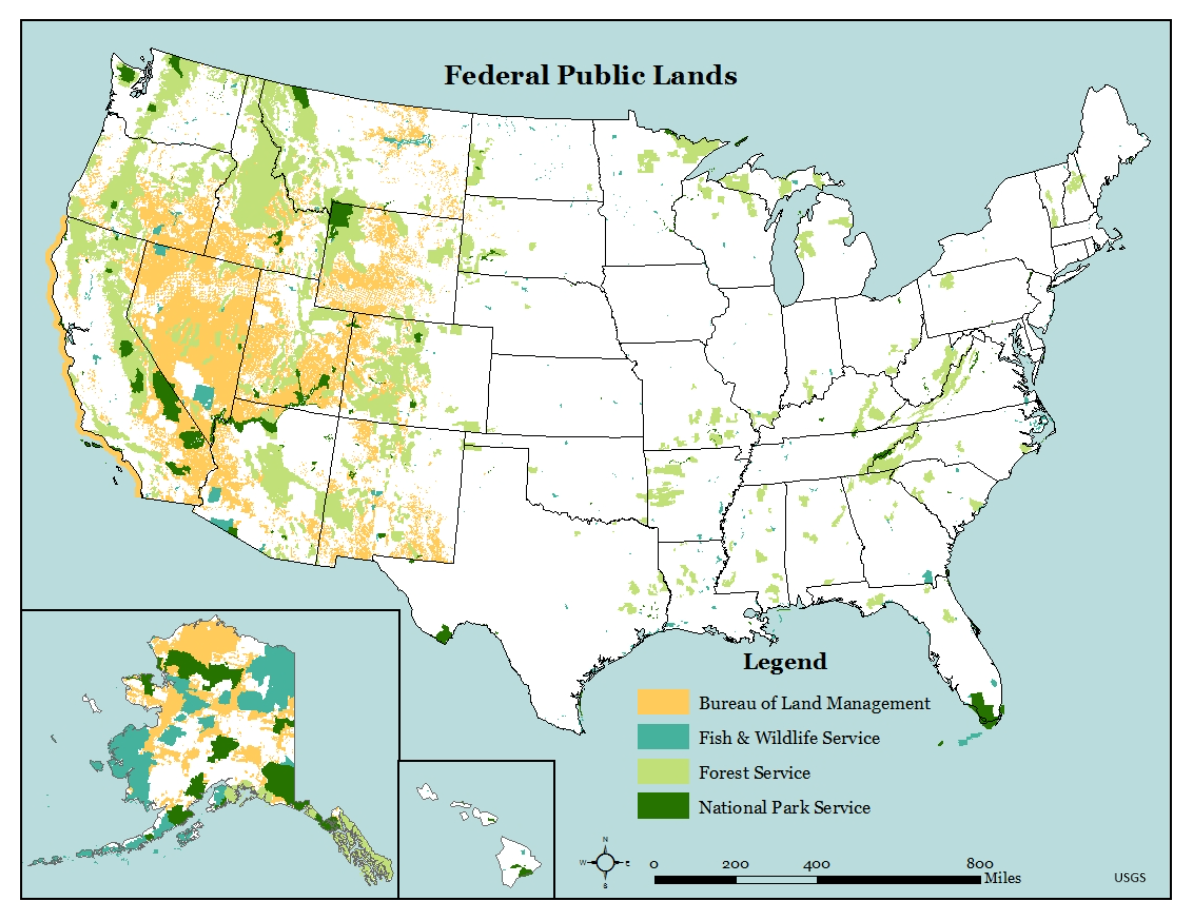
Federal public land is not a monolith. National parks are the most protected and beloved, but most federal acreage is Bureau of Land Management and Forest Service land, where grazing, logging, mining, drilling, hunting, and recreation already coexist under multi-use mandates. The four agencies that manage it are the BLM, the U.S. Forest Service, the Fish and Wildlife Service, and the National Park Service, the last of which alone runs 433 sites visited by a record 331.9 million people in 2024.
The legal backbone is a stack of 20th century laws: the Antiquities Act of 1906, which lets presidents designate national monuments; the Federal Land Policy and Management Act of 1976, which formally ended the policy of disposing of public land and declared retention the default; the Endangered Species Act; the Clean Air and Water acts; and the National Environmental Policy Act. It is no accident that the modern attack on public land began precisely when those environmental laws were passed in the 1970s. The legal architecture protecting the land and the movement to dismantle it were born at the same moment.
The First Sagebrush Rebellion
The original "Sagebrush Rebellion" of the 1970s and 80s took its name from the sagebrush steppe that covers much of the West, where federal holdings range from 20 to 85 percent of a state's area. Western ranchers, miners, and their legislators wanted the federal government to hand the land over to the states, or to privatize it outright. The fight was waged mainly in state legislatures, where Nevada, Utah, Wyoming, Alaska, Oregon, and Arizona considered bills demanding transfer. Senator Orrin Hatch introduced a bill that would have let state land commissions take over some 600 million acres nationwide.
The rebellion courted Ronald Reagan, who declared himself a "rebel." His election and his appointment of property-rights advocate James Watt as Interior Secretary defused the movement. Watt did not pursue wholesale transfer, but he rolled back regulations and promised more local say. The rebellion did not die. It went dormant, and it has reawakened under every president since who has tried to use public land for conservation, resurfacing under Clinton over grazing and new monuments, and again under Obama.
The Money and the Model Bills: The Coordinated Part
This is where the word "conspiracy" earns scrutiny, because some of what conspiracy-minded critics describe is documented fact. The land transfer movement is not purely grassroots. It runs substantially on organized money and prewritten legislation.
The American Legislative Exchange Council, founded in 1973 by conservative activist Paul Weyrich, drafts model bills and hands them to state legislators to introduce as their own. ALEC's corporate advisory board has included Exxon Mobil and Altria, and it is funded heavily by the Koch family. Among its model bills is the "Sagebrush Rebellion Act," explicitly designed to create a mechanism for transferring federal land to the states. When lawmakers in Utah and Arizona introduced transfer legislation, they said openly that it was endorsed by ALEC and that they expected it to spread. It did. In a single recent stretch, seven Western states, Utah, Arizona, Wyoming, New Mexico, Colorado, Nevada, and Idaho, passed, introduced, or explored transfer legislation.
So the structure that conspiracy talk gestures at is real: fossil fuel and extraction money flows into think tanks, think tanks write the bills, networked legislators introduce them in statehouses and carry the ideology into Congress, and the same officials show up at closed-door meetings. In 2017 then-Interior Secretary Ryan Zinke gave a closed-door speech to ALEC, an organization actively pushing state control of the very lands his department managed. None of that requires a secret cabal. It is ordinary, well-funded, ideologically coherent influence operating mostly in plain sight, which is both less lurid and more effective than a conspiracy. This is the same machinery we traced in our investigation into how the people in power turn public office into private advantage.
Where It Tips Into Genuine Conspiracy and Violence
The armed wing is a different matter. In 2014 Nevada rancher Cliven Bundy, who owed more than a million dollars in unpaid grazing fees for running cattle on federal land, drew armed supporters who aimed rifles at BLM officers from a freeway overpass. The agency backed down. Senate Majority Leader Harry Reid called the protesters domestic terrorists. In 2016 Bundy's sons Ammon and Ryan led an armed occupation of the Malheur National Wildlife Refuge in Oregon for roughly five weeks, demanding the federal government surrender the land and declaring that it had no constitutional authority to own it at all.
Public lands scholars described this as "round two" of the Sagebrush Rebellion, more brazen and more violent than the first. Tellingly, the occupiers claiming to defend local control were mostly outsiders from Nevada, Arizona, Montana, and Idaho, and even sympathetic locals told them to leave. The constitutional theory animating these standoffs, that federal land ownership is illegitimate, has been rejected by courts repeatedly, but it provides the emotional fuel that the policy machinery exploits.
The 2025 Push: The Most Serious Attempt in a Generation
The current wave is the most consequential yet, because it nearly succeeded through Congress and is being driven from inside the executive branch simultaneously. During the 2025 budget reconciliation fight over the One Big Beautiful Bill Act, House members Mark Amodei of Nevada and Celeste Maloy of Utah slipped an amendment into committee markup mandating the sale of hundreds of thousands of acres in Nevada and Utah. Public outcry stripped it before the full House voted.
The Senate then went further. Energy and Natural Resources Committee Chair Mike Lee of Utah introduced a measure forcing the Forest Service and BLM to sell up to 3.3 million acres and making more than 250 million additional acres eligible for sale. The Senate parliamentarian ruled the mandatory sale violated reconciliation rules. Lee shrank it to between 600,000 and 1.2 million acres, then, facing bipartisan revolt, withdrew it entirely on June 28, 2025.
The threat did not end with Lee's retreat. Polling consistently shows roughly 71 percent of Americans oppose selling public land, and any senator can revive expedited sales in a future reconciliation bill, which is why Senators Bennet, Merkley, Wyden, and Heinrich introduced the Public Lands Integrity Act in 2026 to bar the tactic. Separately, Utah sued to force the federal government to hand over 18.5 million acres of BLM land, backed by Idaho and a sympathetic bill in Montana; the Supreme Court declined to hear it in January 2025. And the Interior and Housing departments stood up a joint task force to open public land for development under the banner of affordable housing, a softer rationale for the same disposal.
The Executive Squeeze: Monuments and Mining
While Congress attacks from one side, the executive branch works the other. In March 2025 the administration issued an executive order making mineral production the "primary land use" of any federal land containing deposits, elevating mining above recreation, wildlife, and cultural preservation wherever legally permitted. Interior Secretary Doug Burgum, a billionaire with oil and gas ties, ordered a review to redraw national monument boundaries.
The monument fight has deep roots. In his first term Trump shrank Bears Ears by 85 percent and Grand Staircase-Escalante by about half, the largest rollback of federal land protection in American history, after a review of 27 monuments. Biden restored them in 2021. In 2025 a 50-page Justice Department opinion claimed that the Antiquities Act, which only grants the power to create monuments, implicitly carries the power to abolish them, contradicting a century of interpretation. The Wilderness Society called it the legal equivalent of throwing a dart and painting a bullseye around it. At least six monuments are now eyed for reduction, with tribally led monuments such as Bears Ears appearing to be the highest priority, even though December 2024 polling found 75 percent of Utah voters and 88 percent of Arizona voters support presidential monument authority.
Starving the Parks: The Quiet Method
The subtlest attack does not sell or shrink anything. It defunds. Since January 2025 the National Park Service has lost roughly a quarter of its permanent workforce, more than 4,000 people, through layoffs, buyouts, and pressured resignations, even as visitation hit records and 26 parks set new attendance highs. The administration's 2026 budget proposed cutting roughly 900 million dollars and over 5,000 jobs from the Park Service, the largest cut in its 109-year history; the 2027 proposal sought a further 736 million dollar reduction. Across all four land agencies, funding could fall by more than a third from 2024 levels. The system already carries more than 23 billion dollars in deferred maintenance.
Why It Keeps Happening
The motives stack neatly. Extraction industries want access to coal, oil, gas, uranium, and minerals locked beneath protected ground. Anti-federal ideology, genuine in some ranchers and weaponized by funders, frames Washington ownership as tyranny. Budget hawks see acreage as a one-time revenue source to offset tax cuts, which is precisely the slippery slope critics fear: sell a little for the 2026 budget, and the precedent invites selling more in 2028 and 2030. And a transfer to states is widely understood as a path to privatization, because states facing the firefighting and management costs the federal government currently absorbs would likely sell to balance their own books. This pattern, where a public asset is quietly converted into a private revenue stream, is one we have examined before in our look at how headline measures of national wealth obscure what is actually being lost.
The honest conclusion separates the documented from the speculative. There is no single secret meeting where powerful people decided to steal America's land. What exists is more durable: a decades-long, openly funded, ideologically aligned network of donors, think tanks, legislators, and agency officials who pursue the same goal through legislation, litigation, executive order, and budget cuts, occasionally accompanied by armed men with rifles who take the rhetoric literally. The land has survived this siege so far mainly because it is genuinely popular across party lines, with roughly seven in ten Americans opposed to selling it. That popularity, more than any law, is what keeps the inheritance intact, and it is the one thing the movement has never managed to buy.
Frequently Asked Questions
How much public land does the United States own?
The federal government holds roughly 640 million acres of land in trust for its citizens, about 28 percent of the country. It is managed by four agencies: the Bureau of Land Management, the U.S. Forest Service, the Fish and Wildlife Service, and the National Park Service. The Park Service alone runs 433 sites, which drew a record 331.9 million visitors in 2024. Most federal acreage is BLM and Forest Service land governed by multi-use mandates that already allow grazing, logging, mining, drilling, hunting, and recreation.
What is the Sagebrush Rebellion?
The Sagebrush Rebellion was a movement that began in the 1970s and 1980s among Western ranchers, miners, and their legislators who wanted the federal government to hand public land over to the states or privatize it outright. It took its name from the sagebrush steppe of the West, where federal holdings range from 20 to 85 percent of a state's area. The fight was waged mainly in state legislatures in Nevada, Utah, Wyoming, Alaska, Oregon, and Arizona. The movement went dormant after Ronald Reagan's election but has reawakened repeatedly, including armed standoffs in 2014 and 2016 and the 2025 congressional push.
Who is behind the push to sell or transfer public land?
The movement runs substantially on organized money and prewritten legislation. The American Legislative Exchange Council, founded in 1973 and funded heavily by the Koch family, drafts model bills, including a Sagebrush Rebellion Act, and hands them to state legislators. The Utah-based American Lands Council, founded in 2012, pushes transfer through county commissioners and is funded largely by taxpayer-paid county dues. Extraction industries, anti-federal ideology, and budget hawks who see acreage as one-time revenue all converge on the same goal through legislation, litigation, executive order, and budget cuts.
What happened with the 2025 effort to sell public land in Congress?
During the 2025 budget reconciliation fight over the One Big Beautiful Bill Act, House members slipped in an amendment mandating land sales in Nevada and Utah, which public outcry stripped before a floor vote. Senator Mike Lee of Utah then introduced a measure forcing the Forest Service and BLM to sell up to 3.3 million acres and making more than 250 million additional acres eligible for sale. The Senate parliamentarian ruled the mandatory sale violated reconciliation rules. Lee shrank it, then withdrew it entirely on June 28, 2025, saying he could not guarantee the land would not go to China, BlackRock, or foreign interests.
Do Americans support selling public land?
No. Polling consistently shows roughly 71 percent of Americans oppose selling public land, and the opposition crosses party lines. On the related question of national monuments, December 2024 polling found 75 percent of Utah voters and 88 percent of Arizona voters support presidential authority to create monuments. That cross-partisan popularity, more than any single law, is what has kept the land intact through decades of attempts to sell or transfer it.
Kai Tutor | The Societal News Team
Follow Us!
It helps decentralize our presence across the web and it's completely free!
Instagram ➤
Youtube ➤
Substack ➤
X.com ➤
Telegram ➤
TikTok ➤
Sources: High Country News, reporting on the Sagebrush Rebellion and Western land transfer movements | Center for American Progress, analysis of federal land transfer and disposal efforts | National Parks Conservation Association, National Park Service staffing and funding analysis | Earthjustice, litigation and analysis on national monuments and public lands | Grand Canyon Trust, Bears Ears and monument boundary coverage | Congressional Research Service, federal land ownership data and FLPMA background | Brookings Institution, analysis of public land policy and reconciliation | Associated Press, coverage of the 2025 Senate public land sale measure | The Hill, reporting on Mike Lee's land sale proposal and withdrawal | Roll Call, congressional procedure and the One Big Beautiful Bill Act | Salt Lake Tribune, Utah land transfer lawsuit and monument polling