Power Outages in America and the Myth of a First World Electrical Grid
The average American lost 335.5 minutes of power in 2022, roughly three times the figure a decade earlier. Japan loses under 5 minutes a year. The gap between America's self-image and its grid is not subtle. It is embarrassing.
The United States likes to think of itself as the most advanced country on earth, yet its electrical grid tells a different story. In 2022, the average American customer experienced 335.5 minutes of power interruption over the year when major weather events are included, according to Energy Information Administration data reported by industry outlets. That figure has been climbing for a decade. In 2013 the comparable number was around 106 minutes, meaning the typical American household is now losing power for roughly three times as long each year as it was a decade ago. Even California, home to Silicon Valley and some of the wealthiest zip codes in the country, reported a Pacific Gas and Electric SAIDI of about 276 minutes in 2024, driven largely by wildfire related shutoffs.
To understand how bad this actually is, it helps to look at the standard metric utilities and regulators use worldwide, the System Average Interruption Duration Index, or SAIDI, measured in minutes of outage per customer per year. Lower is better. When you place the American numbers next to the rest of the developed world, the gap is not subtle, it is embarrassing.
The Global Benchmark: Minutes, Not Hours
Japan is the global benchmark. In 2023 the average Japanese household experienced less than 5 minutes of power interruption for the entire year, the lowest of any major economy. This is achieved despite Japan being an earthquake prone island nation that has had to rebuild large parts of its generation mix since the Fukushima disaster in 2011, shifting toward renewables and smart grid technology without sacrificing uptime. Germany, a country in the middle of an aggressive and controversial transition away from fossil fuels and nuclear power, reported a national average outage duration of just 11.7 minutes per customer in 2024, an improvement from 12.8 minutes the year before, and below its own ten year average of 12.7 minutes. German regulators explicitly note that the shift to renewables has not degraded reliability, and Germany remains one of the most reliable grids in Europe, trailing only tiny Liechtenstein and Slovenia on the continent. France is similarly strong, with its main distribution operator Enedis maintaining an average annual SAIDI of about 36 minutes, considered among the best performances in the world. The United Arab Emirates, through its Dubai utility DEWA, reports a SAIDI of roughly 1.6 minutes, arguably the best in the world.
South Korea also ranks near the very top globally, alongside Japan, for shortest outage duration and lowest outage frequency, meaning its grid both fails less often and recovers faster when it does. The Netherlands has held a remarkably stable outage duration in the low twenties of minutes for the past five years running, moving from about 23 minutes in 2020 to under 24 minutes in 2024. Britain, using its own metric called Customer Minutes Lost, reported roughly 42 minutes in the 2023 to 2024 reporting year, improving to about 40 minutes the following year, putting it solidly ahead of the American average but behind Germany, France, and the Netherlands.
Even within Europe there is a wide spread, and it is worth noting because it shows reliability is not simply a function of being a rich country, it is a function of policy and investment choices. Hungary reported about 154 minutes and Romania about 185 minutes, both far behind Western Europe, while Albania and Turkey reported outage durations in the thousands of minutes, essentially in a different category of grid altogether. Australia and Canada, two other wealthy, geographically large democracies often compared to the United States, reported average outage durations of about 60 and 55 minutes respectively in recent comparative estimates, both still meaningfully better than the American average even though both countries deal with similarly vast rural distances and harsh weather. China, based on 2013 data, was estimated at 480 minutes, worse than the contemporary United States, illustrating that a developing country with a massive population can still underperform, though China's grid has changed substantially since that data was collected and more recent comparable figures are harder to verify.
Why It Is Happening: Decay and Fragmentation
Why is this happening. The honest answer is a combination of physical decay and political fragmentation, not bad luck with weather.
Start with the hardware itself. A 2015 Department of Energy study found that 70 percent of American power transformers were already more than 25 years old, 60 percent of circuit breakers were over 30 years old, and 70 percent of transmission lines were over 25 years old. A decade later those same transmission lines are approaching 40 years of age on average, even though their typical design life runs from 50 to 80 years, meaning much of the system is not yet past its official expiration date but is well into the stretch where failure rates begin climbing. More recent analysis from Bank of America Institute found that 31 percent of American transmission infrastructure and 46 percent of distribution infrastructure are already near or past their intended useful life. In 2024, 67 percent of what utilities spent on the grid went toward simply replacing old equipment, with only about 32 billion dollars going toward genuinely new lines and substations, compared to 63 billion spent on replacement. The American Society of Civil Engineers has graded the country's energy infrastructure at a D plus, describing it as a 5 trillion dollar problem. Most of this infrastructure was built during the postwar boom of the 1960s and 1970s and was never designed for the electricity demand of a country now running data centers, electric vehicles, and air conditioning loads that did not exist when the system was engineered.
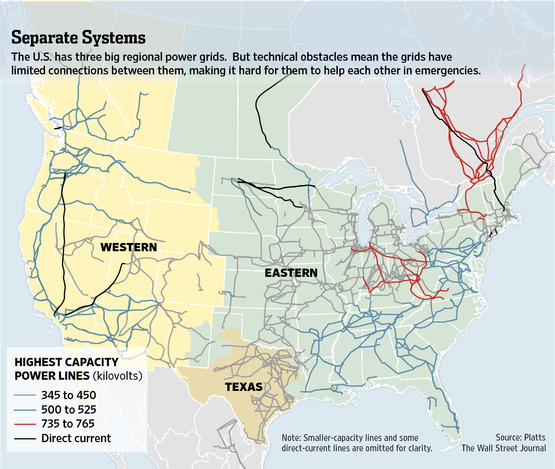
The second and arguably more important problem is structural, not physical. The United States never built one grid, it built thousands. There are more than 3,000 separate electric utilities operating in the country today, a mix of about 210 investor owned utilities, over 2,000 public power utilities, roughly 883 cooperatives, and 9 federal power programs, each with its own management, investment priorities, and often its own state regulator. Compare that to Japan, where 10 vertically integrated regional monopolies run the entire country's power supply under a unified structure, making coordinated investment and maintenance far simpler to execute at scale. The American system is not even physically unified. The country runs on three separate, largely isolated interconnections, the Eastern, Western, and Texas grids, and within those there are 12 different transmission planning regions, only 6 of which are full Regional Transmission Organizations with actual authority to plan transmission for their area. No other major economy on earth operates this way. This is not a technical detail, it is the root cause of why building new transmission capacity in America takes years longer and costs more than in centrally planned systems, and why power cannot easily move from a region with surplus generation to a region in crisis.
Texas: What Fragmentation Produces
Texas is the clearest case study of what this fragmentation produces when combined with deregulation and isolation. In the 1930s Texas utilities deliberately avoided connecting to neighboring states, and the state doubled down on that isolation with electricity market deregulation in 2002 under Senate Bill 7, all specifically to keep the Electric Reliability Council of Texas, or ERCOT, outside the reach of federal regulators. That independence is also what lets Texans shop around for electricity providers, but it came at a steep price.
A subsequent MIT Climate Policy Center study found that roughly 80 percent of the blackouts ordered during Uri could have been avoided entirely if Texas had simply been connected to the rest of the national grid. Four years and billions of dollars in supposed fixes later, ERCOT's own projections show the grid is arguably more fragile than before the storm, with an 80 percent likelihood of rolling blackouts if a storm of Uri's magnitude hits again, compared to just a 5 percent likelihood before 2021.
Climate Volatility: The Compounding Factor
Climate volatility is compounding all of this rather than causing it outright. In 2024, major event days alone averaged nearly nine hours of outage per customer, more than double the roughly four hour annual average recorded from 2014 through 2023, with Hurricanes Beryl, Helene, and Milton responsible for 80 percent of those lost hours and Helene alone cutting power to 5.9 million customers across ten states. The National Oceanic and Atmospheric Administration recorded 27 separate billion dollar weather disasters in 2024 with total costs of 182.7 billion dollars, a five year average now more than double the 45 year historical norm. An aging, fragmented, poorly interconnected grid is simply far less able to absorb that kind of stress than a modern, unified one, which is exactly why Japan and Germany, both of which face their own serious natural disaster risks from typhoons, earthquakes, and windstorms, still post outage numbers a fraction of the American figure. This pattern of a wealthy nation quietly falling behind its peers is one we traced across other measures in our analysis of why the U.S. is the only G7 nation where quality of life is getting worse.
The Comparison Americans Rarely Make Honestly
Now consider the comparison that gives this article its second half, the argument that America has effectively developed a third world electrical grid. This claim is often made rhetorically against Cuba specifically, since American officials and media have long pointed to Cuba's blackouts as proof of the failures of its economic system. Cuba's situation is real and it is severe. Since late 2024 the island has suffered repeated total national grid collapses, not just regional outages but complete, simultaneous failures of the entire electrical system serving all 10 million residents, driven by fuel shortages, a lack of spare parts for aging Soviet era power plants, and the ongoing effects of the United States embargo, which the United Nations General Assembly has voted annually since 1992 to condemn for its impact on Cuban infrastructure investment. As of April 2026, Cuba's National Electric System was generating only about 1,278 megawatts at evening peak against demand of roughly 3,000 megawatts, a deficit of over 1,700 megawatts, with nine thermal plants offline. Rolling blackouts outside Havana have reportedly stretched to 18 to 20 hours a day in the worst periods, and renewables still make up less than 5 percent of Cuba's electricity mix, leaving the country almost entirely dependent on failing fossil fuel plants. This is genuinely one of the worst electricity crises of any nation in the world right now, and it is fair to describe it as a failed grid in a way that no part of the American system currently matches in totality.
But the comparison Americans rarely make honestly is the one within their own borders. Cuba's crisis is a single, unified, total collapse of one small national grid. The American story is different in shape but not necessarily different in substance for the people living through it. Millions of Texans lost power for days during Uri under conditions that killed hundreds of people, a scenario now projected to be more likely to recur, not less. Californians have come to expect deliberate, planned blackouts during fire season as a matter of routine utility policy rather than emergency response. The country as a whole now averages several times the outage minutes of Japan, Germany, France, the UAE, South Korea, and the Netherlands, and its underlying equipment is, on average, older relative to its design life than most of those countries' equipment. The difference between the American grid and Cuba's is not that America has solved the underlying problems, it is that America's failures are distributed across thousands of separate utilities and three disconnected regional grids instead of manifesting as one simultaneous nationwide blackout. Distributed failure is less visible and less politically embarrassing than a single collapse, but it is not obviously better for the family in Houston without power for four days in freezing temperatures, or the family in Northern California living under a preemptive shutoff during wildfire season.
The Diagnosis, and the Proof It Is Fixable
The evidence points to a fairly specific diagnosis rather than a vague sense of decline. American grid reliability lags most of its wealthy peer nations by a wide margin, its equipment is aging faster than it is being replaced, its market structure in places like Texas actively discourages the kind of long term weatherization and interconnection investment that would prevent catastrophic failures, and its regulatory system is split across thousands of utilities and a dozen planning regions in a way no other major economy tolerates. The deeper question this raises, about what wealth is actually for if it does not deliver working infrastructure, is one we examined in our piece on why GDP tells us almost nothing about civilizational success.
Japan proves an earthquake prone island can hit under 5 minutes of outage a year. Germany proves an aggressive renewable transition does not have to sacrifice reliability. France and the UAE prove that dense, well maintained distribution networks can approach near perfect uptime. The United States has the wealth to match or beat any of these countries. What it has lacked, for decades, is the political will to treat the grid as a single national system worth unifying, hardening, and modernizing rather than three thousand separate local problems to be patched one storm at a time.
Frequently Asked Questions
How does U.S. power grid reliability compare to other developed countries?
The gap is wide. In 2022 the average American customer experienced 335.5 minutes of power interruption over the year when major weather events are included, and once the worst storm years are folded in the figure climbs past 300 minutes routinely. By contrast, Japan averaged under 5 minutes of outage in 2023, Germany 11.7 minutes in 2024, the UAE's Dubai utility DEWA roughly 1.6 minutes, France about 36 minutes, and the Netherlands in the low twenties. Even Australia and Canada, both large and weather-exposed, came in around 60 and 55 minutes. The United States sits far above all of them.
Why is the American electrical grid so unreliable?
The honest answer is physical decay plus political fragmentation, not bad luck with weather. A 2015 Department of Energy study found 70 percent of transformers were already over 25 years old and 70 percent of transmission lines over 25 years old. The Bank of America Institute found 31 percent of transmission and 46 percent of distribution infrastructure is near or past its useful life. Structurally, the U.S. never built one grid: more than 3,000 separate utilities operate across three largely isolated interconnections, making coordinated investment far harder than in unified systems like Japan's.
What happened during Winter Storm Uri in Texas in 2021?
Texas deliberately kept its ERCOT grid isolated from neighboring states to stay outside federal regulation, so when Winter Storm Uri hit in February 2021, ERCOT could not import meaningful power. Gas plants froze, and the market structure gave generators no incentive to weatherize. The result was rolling blackouts affecting between 4.5 and 4.8 million customers, at least 210 to 246 deaths, and economic losses estimated between 80 and 130 billion dollars. An MIT study found roughly 80 percent of the blackouts could have been avoided if Texas had been connected to the national grid.
Is it fair to compare America's grid to Cuba's or the developing world?
Cuba's crisis is more severe in totality: since late 2024 the island has suffered repeated complete national grid collapses, with a deficit of over 1,700 megawatts as of April 2026 and blackouts stretching to 18 to 20 hours a day in the worst periods. No part of the American system matches that total collapse. The more honest point is about shape: America's failures are distributed across thousands of utilities and three disconnected grids rather than manifesting as one nationwide blackout. Distributed failure is less visible, but not obviously better for a family in Houston without power for four days in freezing temperatures.
Can the U.S. grid be fixed, and do other countries prove it?
The peer examples show it is a matter of policy and investment, not wealth or geography. Japan proves an earthquake-prone island can hit under 5 minutes of outage a year. Germany proves an aggressive renewable transition does not have to sacrifice reliability, posting 11.7 minutes in 2024. France and the UAE prove dense, well-maintained networks can approach near-perfect uptime. The United States has the wealth to match any of them. What it has lacked is the political will to treat the grid as a single national system worth unifying, hardening, and modernizing rather than three thousand separate local problems.
Kai Tutor | The Societal News Team
Follow Us!
It helps decentralize our presence across the web and it's completely free!
Instagram ➤
Youtube ➤
Substack ➤
X.com ➤
Telegram ➤
TikTok ➤
Sources: POWER Magazine, "U.S. Power Distribution System Reliability Has Declined" | PG&E Electric Reliability Reports | NAES, "World Rankings on Power Reliability" | Bundesnetzagentur, 2024 German electricity supply interruptions | iSelect, "The Global Energy Outage Report" | Repath, "Why Climate Change Is Breaking Grid Reliability" | CUBE Concepts, "German Power Grid Remains Stable" | arXiv, energy storage paper with 2013 country SAIDI table | Wikipedia, 2024-2026 Cuba blackouts | Electric Choice, "Cuba Electricity: 2026 Crisis" | UAB Institute for Human Rights, "Cuba's Electricity Crisis" | Utility Dive, "Aging grids drive $51B in annual distribution spending" | EIA, distribution system spending | Bank of America Institute, "Power check: Watt's going on with the grid?" | The National Interest, "Past Its Prime: Aging Transmission Lines" | UT Austin, "The Timeline and Events of the February 2021 Texas Blackout" | Forbes, "After 4 Years And Billions Of Dollars, The Texas Grid Is Not Fixed" | ElectricRates, "Understanding ERCOT: Texas Power Grid Guide" | Rep. Casar, on the MIT study of Uri blackouts | Bipartisan Policy Center, "Grid Regionalization" | RMI, "The U.S. Has the Only Major Power Grid without a Plan"