Ukraine War Costs Revealed: US and NATO Aid vs. Russia, China and North Korea Spending
The Financial Scale of the War
The Russian invasion of Ukraine in February 2022 marked the beginning of one of Europe's most significant conflicts since World War II, prompting an unprecedented international response in financial, military, and humanitarian support. Unlike direct U.S. involvement in past wars, the aid to Ukraine represents a form of proxy assistance where Western nations bolster Ukraine's defense without deploying their own troops en masse.
While aid to Ukraine has been vital in sustaining the country's resistance, it remains modest compared to the trillions spent on world wars and prolonged counterinsurgencies. However, when viewed as a percentage of GDP or in per-year terms, the commitment reveals the evolving nature of geopolitical support in the 21st century. The figures below rely on the latest available data as of late 2025, noting that aid totals continue to evolve.
U.S. Aid to Ukraine
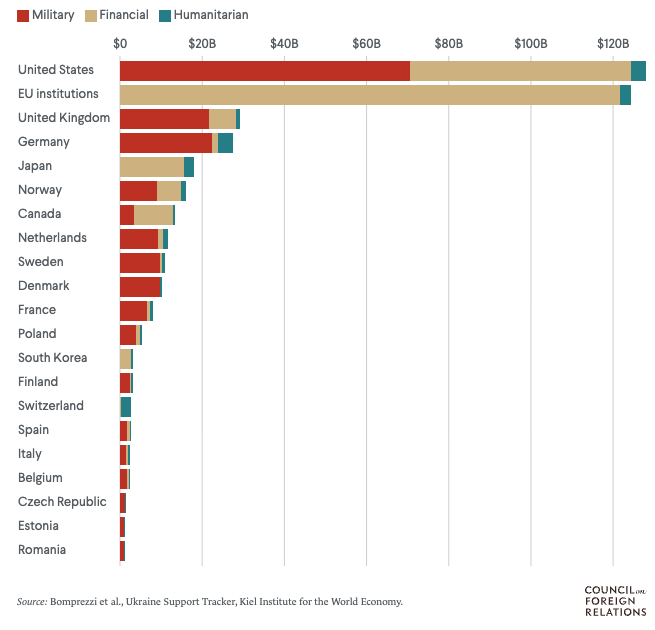
Since the invasion began, the United States has emerged as the single largest bilateral donor to Ukraine, channeling funds through congressional appropriations and executive actions. According to the Council on Foreign Relations, Congress has passed five major aid bills totaling approximately $175 billion in allocated spending. As of August 2025, the Kiel Institute reported U.S. spending at $130.6 billion, with projections pushing toward $175 to $183 billion by year's end including undelivered commitments.
Breaking down U.S. aid by category:
- Military aid: Around $65 to $70 billion, including weapons transfers such as Javelin missiles, HIMARS systems, Patriot air defenses, and armored vehicles, drawn from U.S. stockpiles or funded through the Ukraine Security Assistance Initiative (USAI). By January 2025, the U.S. had provided about 20% of Ukraine's military equipment in active use.
- Financial and economic support: Over $30 billion in direct budget support to keep Ukraine's government operational, including salaries for civil servants and pensions, crucial amid wartime economic disruptions.
- Humanitarian and other aid: Approximately $20 to $25 billion for refugee assistance, food security, and reconstruction efforts, coordinated through USAID and the State Department.
The U.S. aid represents a strategic investment in European stability, with oversight mechanisms like the Ukraine Oversight initiative ensuring accountability. Adjusted for inflation, this equates to roughly 0.2 to 0.3% of U.S. GDP annually, a fraction of peak wartime spending in historical conflicts.
EU and NATO Contributions
While the U.S. leads in bilateral terms, the European Union and its member states have collectively provided more aid overall, emphasizing financial loans and humanitarian efforts. The EU's assistance totals close to $104 billion in direct support, with over $70 billion in military aid and up to $18 billion in macro-financial assistance. Including bilateral contributions from EU members, the total rises to about $197 billion as of November 2025. Loans comprise around 35% of this figure, often backed by frozen Russian assets.
NATO, as an alliance, does not provide aid directly but coordinates member contributions through forums like the Ukraine Defense Contact Group, which has secured nearly $25 billion in pledges. Non-EU NATO members like the UK ($16 to $20 billion), Norway ($7 to $8 billion), and Canada add to the tally. Overall, European allies including the UK and Norway have committed around $204 billion, with $166 billion disbursed by mid-2025.
Key bilateral donors include Germany with 30 to 40 billion euros in military and financial aid, and the UK with 12 to 15 billion pounds (approximately $15 to $19 billion USD). Smaller nations like Latvia and Estonia, contributing 0.7 to 1% of their GDP, have far outpaced larger economies proportionally. Combined international aid from 41 countries totals over $380 to $430 billion in pledges, with $309 to $400 billion committed by June 2025. When including refugee support (over $131 billion for EU-hosted Ukrainians), the EU's effective total exceeds $250 billion.
Russia's Direct War Costs
Russia, as the aggressor, has borne the heaviest financial burden, with estimates placing total expenditures at around $550 billion since the February 2022 invasion. This includes military operations, equipment losses, personnel costs, and economic disruptions. According to Ukraine's Foreign Intelligence Service, this sum equates to 24 annual higher education budgets or 22 healthcare budgets in Russia. For 2025 alone, Russia disclosed spending 11 trillion rubles (about $135 billion), representing 5.1% of its GDP and marking the first official acknowledgment of annual war costs.
In the first three quarters of 2025, open military budget items totaled 4.816 trillion rubles, while classified expenditures reached 7.038 trillion rubles, a 39% annual increase. These costs exclude broader economic impacts such as frozen reserves ($340 billion) and sanctions-induced losses. Averaging $150 to $200 billion annually, Russia's outlay far exceeds Western aid per year but reflects the inefficiencies of a protracted invasion.
China, North Korea, and Iran: Russia's Supply Chain
China's indirect support has been primarily economic rather than directly military, serving as a financial lifeline through surged trade and dual-use exports. Bilateral trade doubled from pre-war levels, reaching $245 billion in 2024 and continuing into 2025. From 2022 to 2025, cumulative trade likely exceeded $900 billion, with China absorbing Russian energy exports and supplying goods to fill sanction gaps. China also provided drone components including batteries and cables, intelligence sharing on Ukrainian targets, and joint military exercises. Yuan-denominated trade now accounts for 30% of Russia's external dealings.
North Korea has supplied Russia with significant military hardware and personnel since 2023, valued at up to $9.8 to $10 billion. This includes artillery shells, rockets, missiles, heavy weapons, and troops deployed in Russian uniforms. Soldiers reportedly earn $2,000 monthly, generating additional revenue for Pyongyang. In return, Russia provided food, fuel, and military gear worth about $980 million, roughly one-tenth of North Korea's contributions.
Iran's contributions include a $1.75 billion deal for 6,000 Shahed-136 drone units, produced in Russia by September 2025. Each drone costs $20,000 to $50,000, enabling cost-effective long-range strikes. Payments included $104 million in gold, though Iran has expressed dissatisfaction over undelivered promises including Su-35 jets.
How Ukraine Aid Compares to Past U.S. Wars
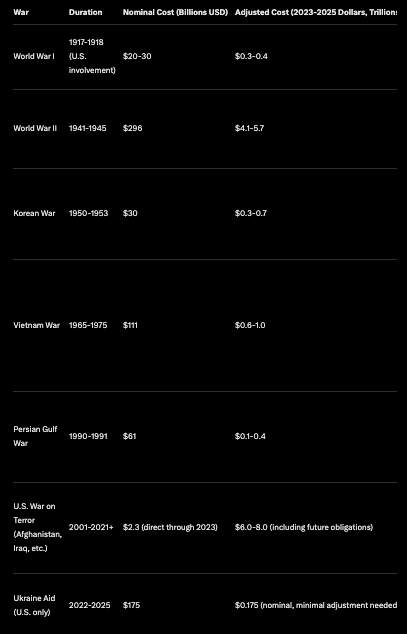
U.S. aid to Ukraine ($175 billion over roughly four years) is comparable to the inflation-adjusted cost of the Korean War but is a fraction (2 to 3%) of World War II's trillions or the War on Terror's $8 trillion, which spanned two decades and included direct combat. Ukraine aid averages $40 to $45 billion per year, similar to Vietnam's annual spend (approximately $50 to $100 billion adjusted) but without U.S. casualties. World War II peaked at over $1 trillion per year in adjusted terms.
As a percentage of GDP, Ukraine aid is negligible compared to World War II's 40% of GDP or even Korea's 5%. The War on Terror, at 1 to 2% of GDP per year, highlights how sustained low-intensity conflicts accumulate massive costs over time. Historical wars also incur ongoing expenses such as veteran benefits. Vietnam's total, for example, includes $555 billion in such costs. Ukraine aid may similarly lead to substantial future reconstruction costs, estimated at $524 billion total for Ukraine's rebuilding.
The Bigger Picture
The aid to Ukraine underscores a strategic shift from direct intervention to allied support, allowing the U.S. and NATO to counter aggression at a lower human cost but still significant financial one. While totaling hundreds of billions, it remains modest relative to the existential threats of past world wars. This comparison reveals the hidden toll of prolonged engagements like the War on Terror, where future obligations such as $1.1 trillion for Iraq and Afghanistan veterans balloon the true totals.
As the conflict persists into 2026, sustaining aid will require balancing domestic priorities with global security, potentially drawing on innovative funding mechanisms like seized Russian assets. The true cost of war, as always, extends beyond dollars to lives lost and long-term stability.
Kai Tutor | The Societal News Team
Follow Us!
It helps decentralize our presence across the web and it's completely free!
Instagram ➤
Youtube ➤
Substack ➤
X.com ➤
Telegram ➤
TikTok ➤