CIA Secret War Inside Mexico: Ground Branch Operations, Ryan Wedding, El Mencho, and the Paper Trail Nobody's Supposed to See
Two CIA agents died in Chihuahua. A Sinaloa operative was killed by a car bomb. El Mencho was taken out one month after Ryan Wedding's arrest. Here is the full documented timeline of America's covert war inside Mexico, and why both governments are denying it.
The Full Timeline
| Date | Event |
|---|---|
| Oct 2024 | Andrew Clark, Ryan Wedding's right-hand man, arrested in Zapopan by Mexican navy and Interpol. Turns FBI informant almost immediately. |
| Jan 20, 2025 | Trump signs Executive Order 14157 on his first day back in office, directing the State Department to designate major cartels as Foreign Terrorist Organizations. |
| Feb 20, 2025 | Six Mexican cartels officially designated FTOs, providing legal cover for expanded CIA covert action under Title 50 authority. |
| Mar 6, 2025 | Ryan Wedding added to the FBI Ten Most Wanted Fugitives list. A $15 million reward is offered. |
| Late 2025 | Trump formally expands CIA authority for lethal targeting and covert action across Latin America. CIA Ground Branch escalates operations inside Mexico. |
| Jan 22, 2026 | Ryan Wedding surrenders at the U.S. Embassy in Mexico City and is flown to California within hours. |
| Feb 22, 2026 | El Mencho, leader of CJNG and the most wanted man in both Mexico and the U.S., killed in a Mexican military operation in Tapalpa, Jalisco, with U.S. intelligence support confirmed by the White House. CJNG retaliates across 22 states, killing 25 National Guard members. |
| Mar 28, 2026 | Francisco "El Payin" Beltran, Sinaloa Cartel operative, killed by a car bomb on the Mexico-Pachuca highway near Tecamac. Multiple sources tell CNN the assassination was facilitated by CIA Ground Branch. |
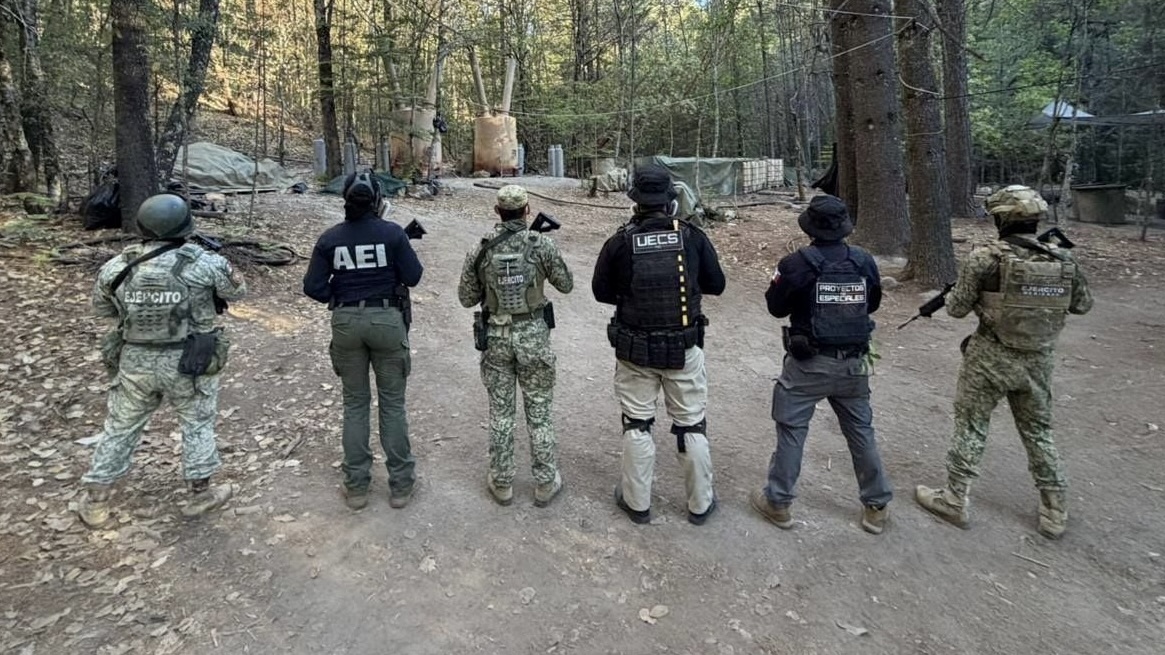
| Apr 2026 | Two CIA Ground Branch operatives and two Mexican officers die in a car crash in Chihuahua after participating in a meth lab raid. Sheinbaum says she was not informed. Mexico's federal government says it did not authorize the CIA's presence. |
| May 12, 2026 | CNN publishes exclusive reporting on the CIA's expanded assassination campaign inside Mexico. The New York Times independently corroborates key details. |
| May 13, 2026 | Sheinbaum calls the reporting "a fiction the size of the universe." The CIA calls it "false and salacious" without specifying what is false. Both CNN and NYT stand by their reporting. |
A Car Bomb on a Mexican Highway
On March 28, 2026, a Toyota truck erupted into a fireball on the Mexico-Pachuca highway near Tecamac, just outside Mexico City. Video circulating online showed the vehicle bursting into flames as it rolled forward, eventually drifting off the road. Inside were Francisco "El Payin" Beltran, an alleged mid-level operative with the Sinaloa Cartel, and his driver, Humberto "N." Both were found slumped in their seats.
At first, Mexican analysts debated whether it was cartel-on-cartel warfare, increasingly common in the violent fractures ripping through the Sinaloa Cartel since the 2024 U.S.-facilitated capture of Ismael "El Mayo" Zambada. The explosion was too precise, too clean for a normal hit. Someone had planted an explosive device inside the vehicle. The State of Mexico's Attorney General confirmed as much to CNN.
What Mexican investigators were not saying publicly, and what CNN's investigation eventually revealed, was that this was not cartel violence. It was, according to multiple sources briefed on the operation, a targeted assassination facilitated by officers from the CIA's elite paramilitary Ground Branch unit.
This was not an isolated incident. CNN's reporting, independently corroborated in key respects by the New York Times, described an expanded and previously unreported CIA campaign operating inside Mexican territory since at least late 2025. American operatives were not just advising or sharing intelligence. They were directly participating in lethal operations.
The Legal Architecture - Trump Made It Possible
The CIA does not simply show up in foreign countries and start killing people. Or at least, not without paperwork. The legal transformation that enabled the current operations in Mexico began on January 20, 2025, literally Trump's first day back in office.
Executive Order 14157, signed that day, directed the Secretary of State to designate major cartels as Foreign Terrorist Organizations. By February 20, 2025, Secretary Marco Rubio had officially listed six Mexican groups: the Sinaloa Cartel, CJNG (Jalisco New Generation Cartel), Cartel del Noreste, the Gulf Cartel, La Nueva Familia Michoacana, and Carteles Unidos.
The U.S. ambassador to Mexico, Ronald Johnson, is himself a former Army Green Beret and CIA officer. Sources described him to CNN as "integral to this whole effort." He is not merely a diplomat. He is, by that account, an operational figure in a covert war.
The legal machinery was constructed first. The operations came after. This is not improvisation. It is doctrine.
The Snowboarder and the Snitch
To understand the current moment, you have to understand Ryan Wedding and the cascade of events his arrest set in motion.
Wedding, born in Thunder Bay, Ontario, represented Canada at the 2002 Winter Olympics in Salt Lake City in the men's parallel giant slalom. By 2010 he had been convicted of cocaine conspiracy in the U.S. and was imprisoned until 2011. It was inside federal prison, according to investigators, where Wedding made the connections that would transform him into what FBI Director Kash Patel called "the largest narco trafficker in modern times."
Wedding's criminal enterprise allegedly moved 60 tonnes of cocaine per year, sourced from Colombia, transited through Mexico via the Sinaloa Cartel's Los Chapitos faction, and distributed across North America. He operated out of Mexico City, living between luxury hotels while his organization accumulated millions. He went by "El Jefe." He placed a $5 million bounty on a man he considered a snitch.
The unraveling of the Wedding operation contains a dark irony. The man Wedding had hunted and eventually had killed, Jonathan Acebedo-Garcia, shot in Colombia in early 2025, was an FBI informant. But in killing the "rat," Wedding actually accelerated his own exposure. His right-hand man, Andrew Clark, was captured in October 2024 in a dramatic operation in Zapopan involving the Mexican navy and Interpol. Authorities seized Clark's phone, which contained encrypted messages on the Threema app: communications with Wedding, drug couriers, and a hitman.
Clark almost immediately began cooperating with the FBI. Between February and November 2025, he met with investigators numerous times. The evidence he provided was decisive. With Mexican authorities tightening the ring around Wedding and, critically, the Los Chapitos withdrawing their protection for reasons that remain publicly unexplained, Wedding ran out of options. He surrendered to the U.S. Embassy in Mexico City on January 22, 2026.
One month after Wedding's arrest, on February 22, 2026, Mexican special forces with U.S. intelligence support killed El Mencho, the most wanted man in both Mexico and the United States, in a compound in Tapalpa, Jalisco. The timing was immediately noticed. Wedding's lawyer explicitly denied any connection. That denial may be technically accurate: the intelligence chain that led to El Mencho was built over years. But Andrew Clark had handled logistics for both the Sinaloa Cartel and CJNG. The question of what intelligence was passed, to whom, and when, remains publicly unanswered.
El Mencho Falls: The Most Consequential Killing in Decades
The February 22, 2026 operation in Tapalpa, Jalisco was a watershed moment in Mexican narco history, arguably the most significant elimination of a cartel leader since Pablo Escobar died on a Medellin rooftop in 1993.
Nemesio "El Mencho" Oseguera Cervantes had led CJNG since around 2010. Under his leadership the cartel expanded from a regional Jalisco operation into a transnational empire with presence in all 50 U.S. states, generating an estimated $8 billion annually in cocaine and $4.6 billion in methamphetamine. He had evaded capture for over a decade despite $15 million rewards from both governments.
The operation succeeded because of patient surveillance work: Mexican intelligence tracked one of El Mencho's romantic partners to his location in Tapalpa. They waited two days, confirmed his presence, and moved on February 22 with six military helicopters, special forces on the ground, and, per the White House's own statement, U.S. intelligence support that was "instrumental" in locating him.
What followed El Mencho's death was a demonstration of organizational muscle that shocked both the Mexican government and Washington. CJNG unleashed coordinated retaliatory violence across 22 states simultaneously: burning vehicles, blocking highways, attacking gas stations, engaging military forces in open combat. Guadalajara, a 2026 FIFA World Cup host city, turned into a ghost town. Airlines cancelled flights. U.S. FBI and CIA personnel had to be evacuated in a scramble from locations caught in the violence.
The CIA Agents Who Died in Chihuahua
In late April 2026, the covert war went briefly and horrifyingly public. Two U.S. Embassy officials, subsequently identified as CIA Ground Branch operatives, died in a car crash in the mountainous region of Chihuahua, along with two Mexican law enforcement officers: First Commander Pedro Roman Oseguera Cervantes and Officer Manuel Genaro Mendez Montes of the State Investigation Agency.
The official initial story from Chihuahua's Attorney General: they were returning from an operation to dismantle synthetic drug labs in the mountains between Morelos and Guachochi. The labs were found using drone surveillance and described as one of the largest ever found in Mexico. The Americans, per this account, were "instructor officers" carrying out "training tasks." Within hours, that story was revised: the local prosecutor walked it back, saying U.S. agents were not in the operation at all and had simply joined the group afterward.
CNN's subsequent investigation established that all four CIA operatives present, including the two who died, were Ground Branch members. They had taken part in the meth lab raid. They were dressed in plain clothes with faces partially covered. Mexico's federal government had not authorized their presence.
The Chihuahua operation being run through state rather than federal government channels appears to have been deliberate: an end-run around Mexico's federal sovereignty requirements, using a willing state government as a side door. It is unlikely to have been unique.
Why Everyone Says No While Nodding Yes
The pattern of denial surrounding these operations is itself revealing. When CNN published its investigation on May 12, 2026, three separate institutional actors immediately pushed back.
CIA Spokesperson Liz Lyons said the report was "false and salacious" and "serves as nothing more than a PR campaign for the cartels and puts American lives at risk." She did not specify which aspect of the reporting was false.
President Sheinbaum called it "based on lies" and "a fiction the size of the universe," while noting that the CIA itself had to deny it, which "shows how big the lie is." She had previously acknowledged CIA intelligence was "instrumental" in the El Mencho operation.
Security Secretary Omar Garcia Harfuch said: "Cooperation with the United States exists, is important, and has yielded relevant results. However, it is carried out under clear principles: respect for sovereignty, shared responsibility, mutual trust, and cooperation without subordination." He explicitly confirmed the cooperation exists while contesting the characterization of how it operates.
A senior researcher from the National Autonomous University of Mexico told CNN that "Mexico's federal government is acutely aware of the CIA's presence in the country, but it hasn't decided how aggressively to try to control what the agency is doing there, or how transparent to be about it to the public." That may be the most honest sentence in the entire affair.
Sheinbaum's Impossible Position
Mexican President Claudia Sheinbaum is attempting something politically dangerous: maintaining the fiction of full sovereignty while tolerating, or at minimum not actively expelling, an escalating covert U.S. presence on Mexican soil.
The pressure from Washington has been relentless since Trump's return to office. He has threatened to deploy U.S. military forces into Mexico if cartel trafficking is not curtailed. He has used tariff threats as leverage. He said in a speech that a "land force" was already in place in Mexico to eliminate traffickers. And he has made clear that if Mexico does not perform, the U.S. will act unilaterally.
For Sheinbaum, a left-wing nationalist whose political base is deeply suspicious of U.S. interventionism, accepting CIA operations on Mexican soil, even tacitly, is politically toxic. Her predecessor AMLO famously dismantled the DEA's network in Mexico and framed U.S. anti-drug cooperation as a sovereignty violation. Sheinbaum has gradually reversed that posture, but not publicly.
What has emerged is a kind of don't-ask-don't-tell arrangement. The federal government acknowledges "intelligence sharing" and "cooperation," denies knowledge of any "unilateral operations," and periodically expresses outrage when operations go visibly wrong, as they did in Chihuahua. The state governments of places like Chihuahua, meanwhile, appear to have their own bilateral arrangements with U.S. agencies that bypass Mexico City entirely.
Ground Branch: The Unit Behind the Operations
The CIA's Ground Branch is not the agency's spy division. It is its paramilitary arm: staffed largely by former Special Operations Forces personnel, particularly Delta Force and Navy SEAL veterans, tasked with direct action missions in denied or hostile environments. Its operators work without the legal protections of uniformed military personnel. They are deniable assets operating under Title 50 covert action authority.
Ground Branch rose to public prominence after 9/11 as the CIA's hunter-killer element in Afghanistan and Pakistan. Its operators have operated in Iraq, Syria, Somalia, and across the broader counterterrorism theater. Applying that same unit to the Mexican cartel problem represents a significant doctrinal shift: treating a criminal trafficking organization the way the U.S. has historically treated al-Qaeda or ISIS.
The Kingpin Question
U.S. officials describe the current campaign as a "counter-network" strategy rather than a "kingpin" strategy: targeting not just leaders but mid-level "key cogs" throughout cartel organizations. El Payin, the March bombing victim, was mid-level. The CIA's sources told CNN the goal is to "identify vulnerabilities throughout the organization and systematically target lower-tier players."
This is, in theory, a lesson learned from two decades of counterterrorism. The death of Osama bin Laden did not end al-Qaeda. The death of Abu Bakr al-Baghdadi did not end ISIS. The CJNG's response to El Mencho's death demonstrated exactly this organizational resilience: a synchronized, multi-state wave of violence executed within hours of the leader's death, with no central command. Analysts at HSToday noted a reported 37% reduction in fentanyl deaths "in just over a year" that they attributed to the coordinated pressure. Whether that reduction is sustainable, or whether disrupted networks simply adapt, remains the central strategic question.
What We Know, What We Don't, and What Probably Happened
Verified: Trump designated major Mexican cartels as FTOs in early 2025, providing the legal architecture for expanded covert action. Two CIA Ground Branch operatives died in Chihuahua in April 2026 following a meth lab raid, a fact confirmed by Sheinbaum's own furious response. El Mencho was killed February 22, 2026, in a Mexican military operation with U.S. intelligence support confirmed by the White House. Ryan Wedding was arrested January 22, 2026. His right-hand man Andrew Clark became an FBI informant after his October 2024 arrest. The CIA denied CNN's reporting without specifying what was false. CNN and NYT stand by their reporting.
Contested: Whether CIA operatives directly pulled the trigger on the El Payin car bombing or provided targeting support and intelligence. Whether Sheinbaum's federal government was informed of specific operations in advance or chose plausible deniability. Whether Wedding or Clark provided intelligence that contributed to El Mencho's killing. The full scope of how many operations CIA Ground Branch has conducted inside Mexico.
Reasonable inference: The Mexican federal government is aware of a significant portion of CIA activity and is making a political calculation to tolerate it while publicly denying it, to avoid Trump's threatened military intervention. The current operations are unlike anything the CIA has conducted inside Mexico in terms of lethality and direct participation since at least the 1980s. The rapid cascade of major events, from the Wedding arrest to El Mencho's killing to the Chihuahua deaths to the El Payin bombing being publicly revealed, suggests a sustained coordinated intelligence campaign rather than isolated incidents. The Chihuahua operation being run through state rather than federal government channels was deliberate, not accidental.
The Question That Lingers
The denials are loud. The evidence is louder. The United States is conducting lethal covert operations on Mexican soil, not as an aberration, but as deliberate policy under a legal architecture built specifically to enable it. The Mexican government is caught between sovereignty and survival, between its political base and its economic relationship with Washington.
Ryan Wedding's arrest did not cause El Mencho's death. But it happened inside the same intelligence campaign, prosecuted by the same agencies, connected to the same cartel networks. The timing of the dominos falling is striking enough to demand scrutiny rather than dismissal.
What is happening in Mexico is not a drug war in any conventional sense. It is a shadow war, conducted with car bombs, informants, Ground Branch operatives in plain clothes, encrypted messaging apps, and the blunt instrument of presidential covert authority. Whether it is making America safer, or simply exporting violence southward under new management, is a question the official denials will never answer.
The truth sits somewhere between what CNN reported and what both governments want you to believe.
Kai Tutor | The Societal News Team
Follow Us!
It helps decentralize our presence across the web and it is completely free!
Instagram ➤
Youtube ➤
Substack ➤
X.com ➤
Telegram ➤
TikTok ➤