Wagner, Africa Corps, SVR, and Russia's Influence in Africa (2026)
From Wagner to Africa Corps: The Rebrand
The name Wagner Group is, in most of Africa, now officially retired.
On June 6, 2025, the Wagner Group announced it was ending its deployment in Mali after claiming it had "completed its mission" against insurgents, asserting it had killed thousands of militants and rebel commanders. The announcement was framed as a victory. It was anything but.
A major investigation by The Sentry, published in August 2025, revealed Wagner's operations in Mali as a multilayered catastrophe, for the people of Mali, for the ruling junta who brought them in, for regional counterterrorism efforts, and for Russia's own strategy for power and resource extraction in Africa.
The exit from Mali marked not a Russian retreat from the continent but a reorganization: a formal transfer of power from a private mercenary company to a direct arm of the Russian state. In the months following Prigozhin's death, the group broke into pieces. Thousands of men signed contracts with the Ministry of Defense, while others dispersed to Belarus or stayed stationed across Africa. The Kremlin needed to preserve Wagner's overseas network but needed tighter control. The solution was rebranding: Africa Corps, a new formation placed directly under the Ministry of Defense and government intelligence services.
Mali: Where the Contradictions Were Most Exposed
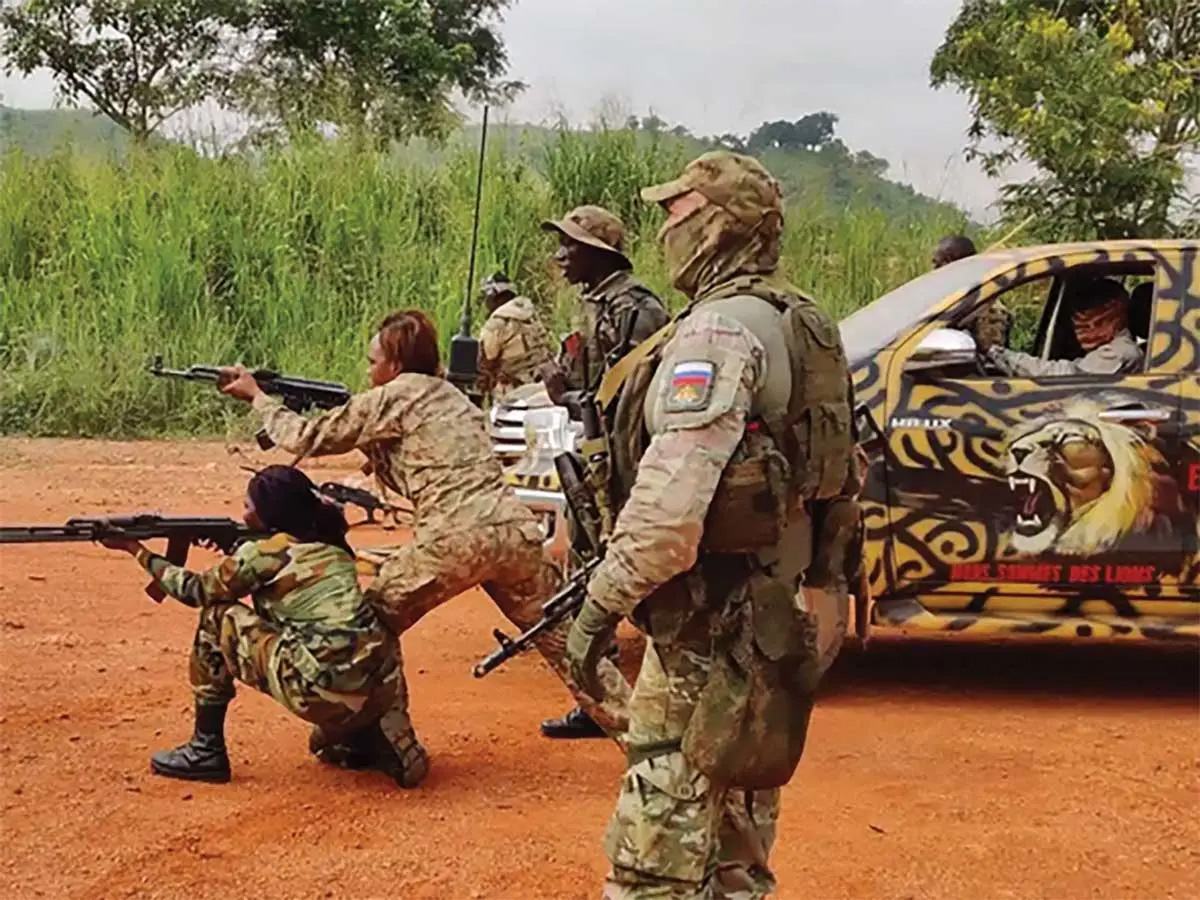
By mid-2025, Africa Corps had absorbed most of Wagner's personnel, equipment, and contracts, particularly in Mali and the Central African Republic. Despite Wagner's announced departure, it remained unclear whether any Russian mercenaries actually left the country. As Wagner left, security advisers from the Africa Corps arrived in their place.
Some Wagner mercenaries were described as so hard-pressed for cash they were pictured selling discount canned sardines at local markets, a far cry from the image of elite fighters Russia had cultivated.
The security reality on the ground was brutal. Since September 2025, the Islamist coalition JNIM imposed a selective blockade of Mali's capital Bamako, burning fuel trucks and imposing gender segregation on transport routes. Although the Malian Army, with the help of an estimated 1,000 Russian combatants from the Africa Corps, secured some fuel convoys, access to fuel had still not fully resumed in Bamako in early 2026. Rumors of internal dissent grew louder, with senior officers reportedly plotting a coup and relations between Malian soldiers and Russian operatives reportedly straining.
The single bloodiest moment for Russia in Mali came in July 2024, when a contingent of Wagner and Malian troops were ambushed by Tuareg rebels near Tinzaouaten, claiming the lives of 84 Russian mercenaries and 47 Malian soldiers. Ukraine's spy agency, the GUR, admitted it provided crucial intelligence to the rebels, and there were reports that Ukrainians taught the rebels to operate drones. In response, Mali broke off diplomatic relations with Ukraine. The ambush was the worst single-day loss for Russian forces in Africa in the history of their deployment.
The Central African Republic: State Capture
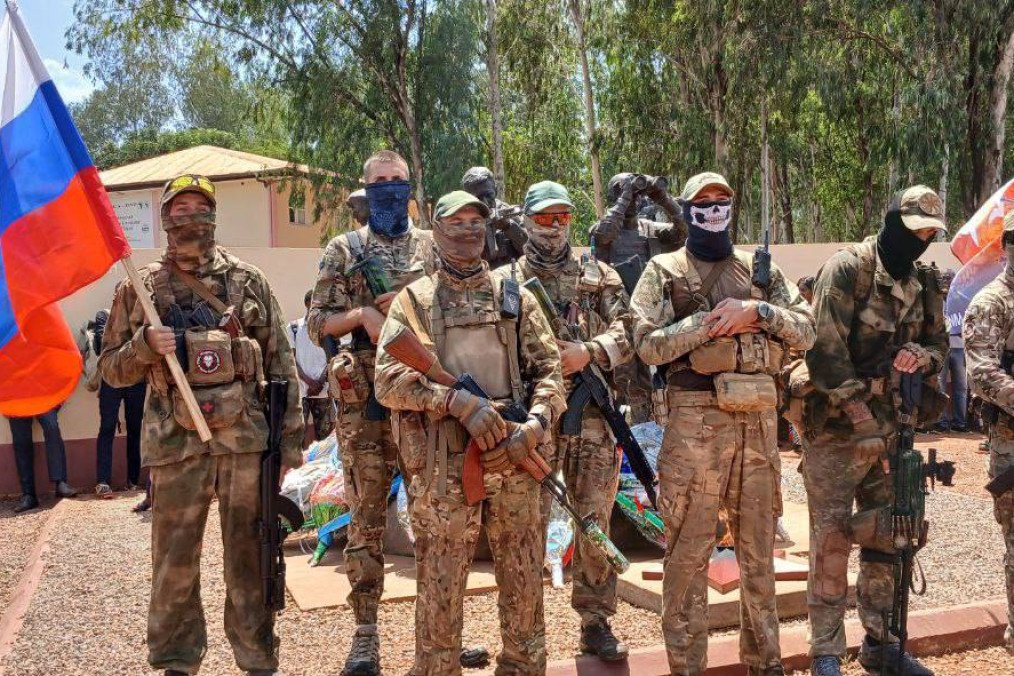
The CAR, where Wagner first arrived in 2018, entered 2025 in a state of profound political tension. In April 2025, thousands of Central Africans protested against President Touadéra's plans to run for a third presidential term with Wagner backing, a sign that Russia's political protection was beginning to fray.
Unlike in Mali, the Russian Ministry of Defense did not fully bring private military contractors under its control in the CAR. The SVR was specifically called upon to help the Defense Ministry avoid hindering Wagner's activities, illustrating the complex and competing power structures Russia operates through in Africa.
The Alliance of Sahel States: Consistently Catastrophic Results
The three Sahel nations that formed the Alliance of Sahel States, Mali, Burkina Faso, and Niger, all expelled Western and UN forces and turned to Russia within a span of three years. The results across all three have been consistently catastrophic for civilian populations.
Fatalities linked to Islamist groups were at record highs across Mali, Niger, and Burkina Faso in the first half of 2024. For the first time in nearly a decade, attacks reached Bamako itself. Some experts estimated that Malian forces and Russian mercenaries would be responsible for a greater number of civilian deaths than Islamist groups in 2024. Increasingly, civilians are more afraid of being killed by Russian mercenaries than by jihadist groups.
Burkina Faso
In mid-2024, Africa Corps announced it would replace Wagner forces with a base established in Loumbila, northeast of Ouagadougou, with plans for 100 personnel expanding to 300. Those expansion plans collapsed almost immediately. A portion of Africa Corps forces were called back to Russia not long after arrival. In May 2025, attacks allegedly killed approximately 200 military personnel in a matter of days.
Niger
Africa Corps deployed a 100-man contingent of instructors to train Nigerien troops at Air Base 101 in Niamey, coinciding with the departure of US forces in April 2024. Increased aerial activity around Air Base 201 in Agadez, formerly used by American forces, with flights coming from Libya signals potential for a long-term Africa Corps installation. In September 2025, Niger and Russia entered talks about potentially developing the country's uranium deposits.
Sudan and Libya: Gold, Naval Ambitions, and the Logistics Hub
Sudan
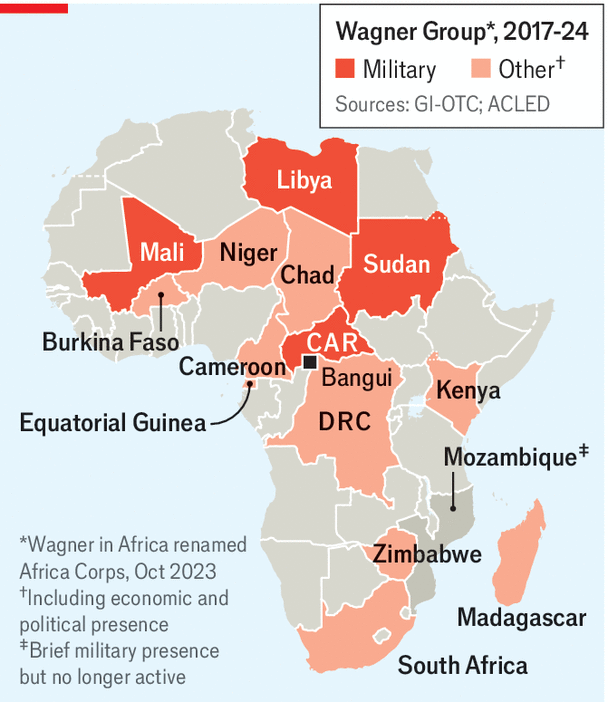
Sudan represents the oldest and most financially lucrative of Wagner's African ventures. The Wagner Group operated under the cover of "M Invest," set up a gold mine near Abidiya in Sudan's northeastern gold-rich belt, and trained troops for both the Sudanese Armed Forces and the paramilitary Rapid Support Forces since 2018. After civil war erupted between the two in April 2023, Wagner initially backed the RSF, then shifted to the SAF in exchange for weapons and permission to establish a naval base on the Red Sea coast. The base never materialized. In November 2025, the Kremlin announced the suspension of the plan due to increasing domestic instability.
Libya
Libya, where Russia controls three air bases at Sirte, al-Jufra, and Brak al-Shati and maintains approximately 800 contractors, remains the logistical nervous system of the entire Africa operation. The collapse of Assad's regime in Syria briefly imperiled Russia's access to Khmeimim air base in Latakia, a crucial refueling hub, but flights resumed and Russia is negotiating to keep access. Russia responded by increasing military transfers through Benghazi and deploying units to Maaten al-Sarra, consolidating a logistics corridor linking Libya to the Sahel and the CAR. Libya also functions as a hub for gold smuggling, sanctions evasion, narcotics trafficking, and the management of migration flows used as a geopolitical lever against Europe.
The SVR's Disinformation Takeover: Africa Politology
The most significant structural revelation of 2025 and early 2026 is one that has received far less attention than the battlefield reports. Russia's foreign intelligence service, the SVR, has quietly assumed control of what was once Wagner's disinformation and political influence empire.
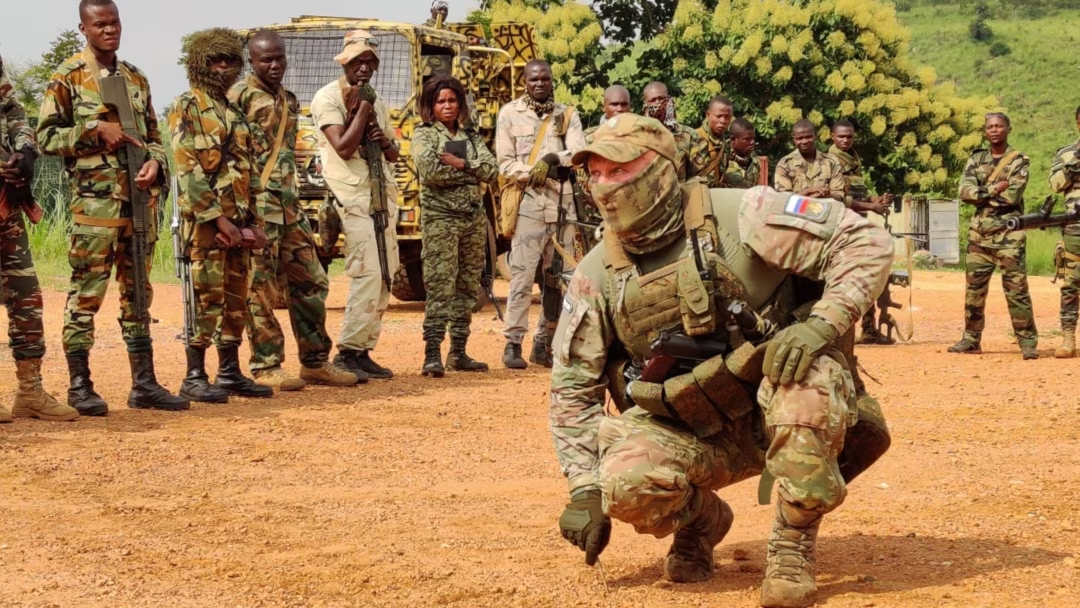
While the Russian Defense Ministry coordinates security operations through Africa Corps, the SVR has assumed Wagner's influence branch, called "Africa Politology" or "The Company," which employs nearly 100 consultants conducting political influence campaigns, disinformation operations, and competitive intelligence across the continent. The SVR intelligence service sometimes competes with the Russian Defense Ministry, which oversees the GRU military intelligence, or has to coordinate with it.
Tactical Wins, Strategic Failure
The evidence assembled by every credible independent analyst in 2025 and early 2026 points to the same conclusion: Russia's Africa strategy is producing tactical wins and strategic failure simultaneously. The security situation in every country employing Russian mercenaries has worsened. Direct ownership of the Africa Corps reflects poorly on Moscow when its mercenaries are completely ineffectual.
Russian-backed regimes in the Sahel are increasingly targets of Gen Z protests spreading across the continent. The Russian economy is expected to continue cooling in 2026, and given mounting losses in Ukraine and ongoing uncertainty over US-brokered peace diplomacy, Russia may be forced to retract some of its global commitments going forward.
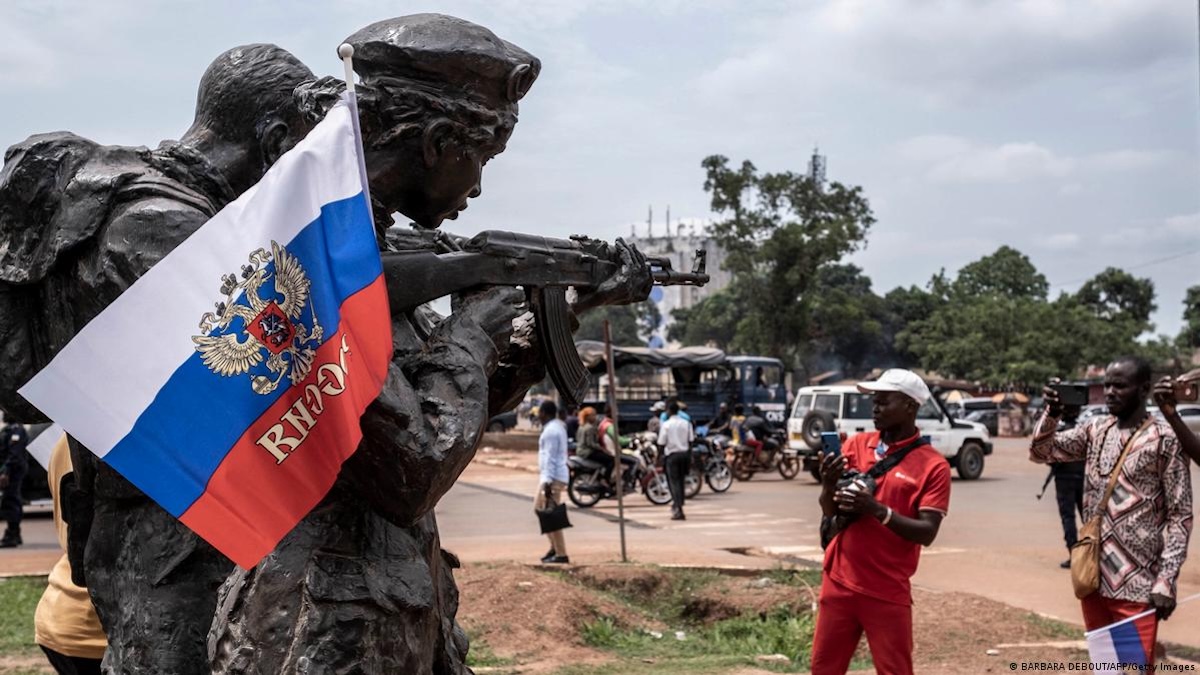
The African populations that were promised security have instead received atrocities. The jihadist insurgencies that Wagner was contracted to eliminate have instead expanded into new territory, pushed by the very brutality Russia employed against the civilian populations that insurgents recruit from. The fuel still does not reliably reach Bamako. The gold still flows out. The SVR consultants are still writing disinformation in a dozen countries. And in the Central African Republic, a bronze statue of the man Putin had killed still stands in front of the Russian House in Bangui, staring out over a country that has been comprehensively looted and only partially pacified: a fitting monument to the entire enterprise.
Sources: RAND Corporation (June 2025), Carnegie Endowment for International Peace (February 2026), Human Rights Watch (July 2025), The Sentry (August 2025), Al Jazeera (June 2025), CNN (August 2025), Small Wars Journal (January 2026), ACLED, Forbidden Stories / Africanews investigation (February 21, 2026), Cambridge Journal of African Law (October 2025), PeaceRep / World Peace Foundation (July 2025), US Department of State, Chicago Journal of Foreign Policy (February 2026).
Kai Tutor | The Societal News Team
Follow Us!
It helps decentralize our presence across the web and it's completely free!
Instagram ➤
Youtube ➤
Substack ➤
X.com ➤
Telegram ➤
TikTok ➤