

How Brainrot Rules Our Minds And Who's Making It Happen

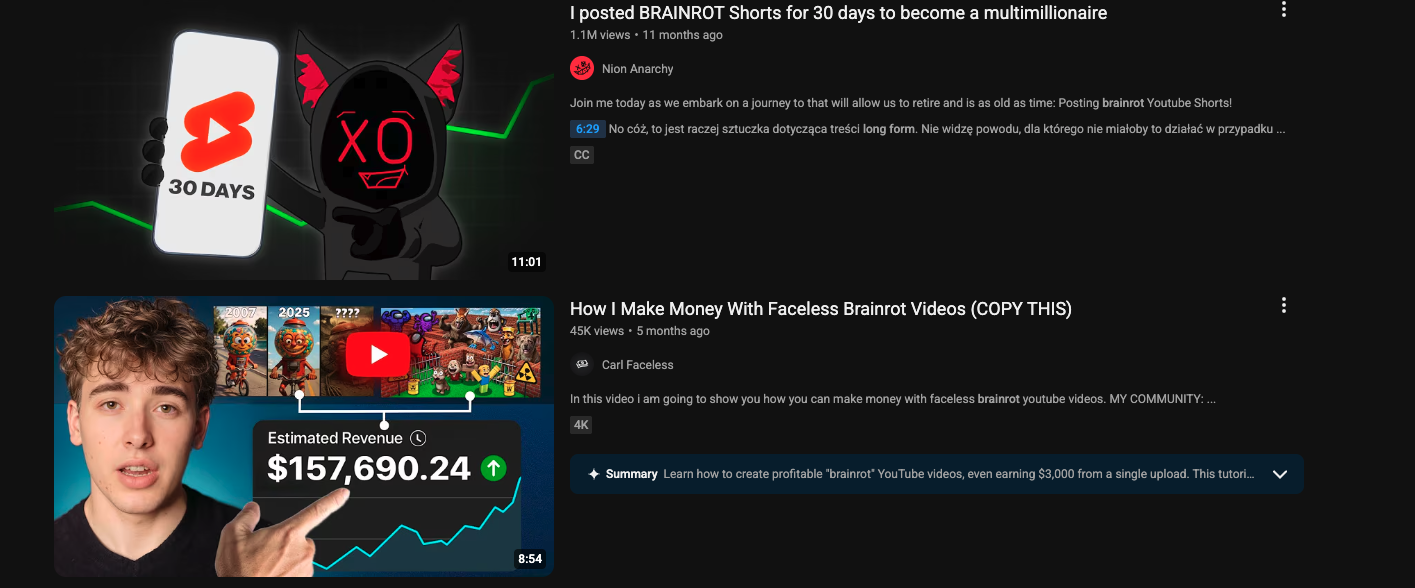
The word started as a meme. A self-deprecating joke people made after spending three hours watching absurdist TikTok videos of anthropomorphic toilets fighting giant cartoon characters.
But brainrot has quietly turned from a punchline to diagnosis. (Ex, "no cap he has Brainrot", "Shucks I got the brainrot", "this brain rot is gas")
At its core, brainrot describes the cognitive and cultural erosion that results from chronic overconsumption of low-effort, high-stimulation content online.
It's what happens when your brain spends years being fed an endless conveyor belt of 15-second videos, outrage tweets, and algorithmically perfected dopamine hits, and slowly loses its taste, patience, and capacity for anything slower or deeper.
It's not just that the content is weird or stupid. The damage is subtler than that. It's about what repeated exposure does to the architecture of your attention, your memory, your tolerance for complexity, and your relationship with boredom.
To understand brainrot, you need to understand dopamine, and more specifically, how platforms have learned to weaponize it.
Dopamine is not, as popularly believed, a "pleasure chemical”.
It's a drive chemical. It makes you want. It fuels seeking behavior. And it is released not just when you get a reward, but most powerfully when a reward is possible but uncertain.
This is called a variable reward schedule, and it is the same psychological mechanism that makes slot machines so difficult to walk away from.
Every time you pull down on your feed and refresh it, you are pulling a lever on a slot machine.
Every notification, every new like, every unexpectedly funny video is a potential jackpot. Your brain learns this pattern fast, and it begins craving the scroll itself, not even the content, just the act of seeking.
Over time, this relentless low-grade stimulation raises your neurological baseline. Content that would have captivated you five years ago now barely registers. Your reward circuitry recalibrates upward.
The world offline, a conversation, a book, a walk, a moment of doing nothing, starts to feel unbearably flat by comparison. And so you reach for the phone again.
Researchers have documented real changes in attention span, memory formation, and impulse control among heavy social media users.
The average human attention span has dropped from around 12 seconds in the year 2000 to roughly 8 seconds today.
Deep reading, the kind that requires sustained attention and builds complex understanding, is becoming harder for people who grew up with feeds. The brain, like any muscle, atrophies when it's not used in a certain way.
Memory is affected too. Shallow, fast content leaves shallow, fast traces. When everything is a 15-second clip experienced in isolation, the brain loses practice at building the layered, narrative memories that form your sense of identity and meaning over time. You remember vibes. You stop remembering ideas.
Brainrot is not an accident. It is the output of a very deliberate engineering project.
Social media platforms are not in the business of connecting people or sharing information, not really.
They are in the business of selling attention to advertisers. The product they sell is your time and your eyeballs. And to maximize that product, they need to keep you on the platform as long as possible, as often as possible.
This created an arms race for engagement. And engagement, it turns out, is not driven by content that is good for you. It's driven by content that triggers strong, fast emotional responses, surprise, amusement, outrage, anxiety, lust, tribalism.
The algorithm doesn't know or care whether a piece of content is meaningful, true, or healthy. It only knows whether you stopped scrolling and watched, liked, shared, or commented.
The infinite scroll, invented by a designer named Aza Raskin, who has since publicly apologized for it, removes every natural stopping point. There is no last page. There is no "you've reached the end”.
The feed is bottomless by design, because every moment of friction is a moment you might leave.
Autoplay removes your agency further. You didn't choose the next video.
The algorithm chose it for you, based on a profile of your psychological vulnerabilities built from thousands of data points. It knows what keeps you watching better than you do.
The result is a media environment optimized not for your flourishing, but for your captivity.
The responsibility for brainrot doesn't sit with one villain. It's distributed across a system, but some actors are more culpable than other.
TikTok, Instagram, YouTube Shorts, and X (formerly Twitter) are the primary delivery mechanisms.
TikTok's recommendation algorithm is widely considered the most powerful and invasive ever built for consumer use. It requires almost no social graph, it doesn't need to know who you follow. It watches what you pause on, rewatch, skip, and like, and within minutes it has a model of your psychology precise enough to serve content that's nearly impossible to put down. ByteDance, TikTok's Chinese parent company, built an instrument of mass psychological capture and then exported it to the rest of the world.
Meta, the parent of Facebook and Instagram,chas known for years that its platforms are harmful, particularly to teenage girls. Internal research leaked by whistleblower Frances Haugen in 2021 showed the company knew Instagram worsened body image, anxiety, and depression in young users, and chose growth over intervention.
Advertisers fund the entire ecosystem. Every dollar spent on social media advertising is a dollar that incentivizes platforms to maximize engagement at any cost. Brands bear collective responsibility for financing a system they know is built on psychological exploitation, even if each individual ad campaign looks innocent in isolation.
Millions of creators,csome of them unwittingly, some quite deliberately, produce the raw material of brainrot. The creator economy rewards volume, virality, and emotional intensity. A thoughtful 20-minute video might reach 10,000 people. A 30-second clip of something absurd or outrageous might reach 10 million. Creators who want to survive financially learn to optimize for the algorithm, which means optimizing for exactly the kind of content that degrades collective attention.
Behind every platform is a class of investors whose only metric is growth. They funded the race to the bottom. They pressured founders to scale fast and monetize hard. When Facebook considered making its feed less addictive in 2018, internal research showed it would reduce engagement, and the idea was quietly shelved.
Regulation of social media platforms has been feeble and slow almost everywhere. The business model of attention harvesting has operated largely unchecked. Children as young as 9 or 10 are on platforms with no meaningful protections. The data collection that powers algorithmic manipulation is barely regulated. Governments have been either too slow, too captured by tech lobbying, or too technologically illiterate to act in time.

The effects of brainrot scale beyond the individual brain. When millions of people share a degraded attention environment, it reshapes culture.
Political discourse has been colonized by the logic of virality. Complex policy becomes a bumper sticker. Nuance is a death sentence in the engagement economy. Outrage travels further and faster than truth, always has, but never more so than now. Entire political movements have been built on meme logic, where feeling and belonging matter more than fact or coherence.
Language itself is changing, a generation of young people communicate in references, in irony stacked on irony, in terminology so niche it functions as tribal coding, "rizz," "NPC," "based," "sigma," "no cap”.
This isn't inherently bad; language always evolves. But when the references cycle faster than meaning can settle, communication starts to hollow out. When everything is ironic, nothing is sincere. When every emotion is a meme format, genuine feeling becomes hard to locate or express.
Young people are also suffering measurable mental health consequences. Rates of anxiety, depression, and loneliness among teenagers and young adults have climbed sharply over the same period as smartphone and social media adoption. The link is debated in its precise mechanism, but the correlation is consistent and the direction is not ambiguous.
One of the most disturbing features of brainrot is that awareness of it doesn't protect you from it. You can understand exactly how the machine works, the dopamine loops, the variable rewards, the algorithmic manipulation, and still find yourself at 2 a.m. watching a video of a raccoon opening a tiny fridge, unable to stop.
This is by design. These systems have been engineered by some of the most talented behavioral scientists, data engineers, and UX designers in the world, armed with more data about human psychology than any government or university has ever possessed. The consumer, armed only with vague awareness and willpower, is not a fair match.
This is why "just put the phone down" is not a solution. It pathologizes the victim while exonerating the system. Expecting individuals to resist what has been purpose-built to overwhelm their resistance is a convenient way for the people who built the machine to avoid accountability.
Real change requires structural intervention, not just personal discipline.
Regulation that treats algorithmic manipulation of minors as a harm, not a product feature, would be a start.
Age verification, bans on addictive design patterns for children, and mandatory data minimization are all achievable policy goals. Several countries are beginning to move in this direction, though progress is slow.
Platform design can change. Chronological feeds, hard limits on autoplay, screen time enforced by the platform rather than weakly suggested by it, these are choices, not technical inevitabilities.
The infinite scroll can be uninvented. Aza Raskin invented it, someone can kill it.
Digital literacy, real literacy, not just the surface-level "think before you share" kind, needs to be embedded in education. Young people should understand how recommendation algorithms work, what engagement optimization means, and how their data is used to model and manipulate them.
And personally, the most subversive act is cultivating slowness. Reading long things. Tolerating boredom. Letting your mind wander without immediately filling the gap with a screen. These are not nostalgic luxuries. They are the practices through which a coherent inner life is built and maintained, and they are exactly what the attention economy is designed to erode.
Brainrot is the predictable output of an economic system that treats human attention as a resource to be strip-mined. The platforms built the machinery. The advertisers funded it. The investors demanded it scale. Regulators looked away. And hundreds of millions of people, most of them never having consented to being psychologically profiled and manipulated, walked into it because it was free, fun, and everywhere.
The minds being shaped by this system are not just individual tragedies. They are a collective one. A society whose attention has been fractured, whose patience has been stolen, and whose capacity for the kind of sustained, difficult thought that democracy and science and meaning-making require, is a society that has been made measurably weaker.
Brainrot is not a joke anymore, its a mind virus, further clarifing that there is a war, a battlefield, for our minds and our attention.
Кай Тутор | Команда Societal News
Следите за нами!
Это помогает децентрализовать наше присутствие в Интернете и совершенно бесплатно!
Instagram➪
Youtube➪
Substack➪
X.com➪
Telegram➪
TikTok ➪